This transcript has been generated using automated tools. It has been checked but minor errors or omissions may remain.
[Intro music]
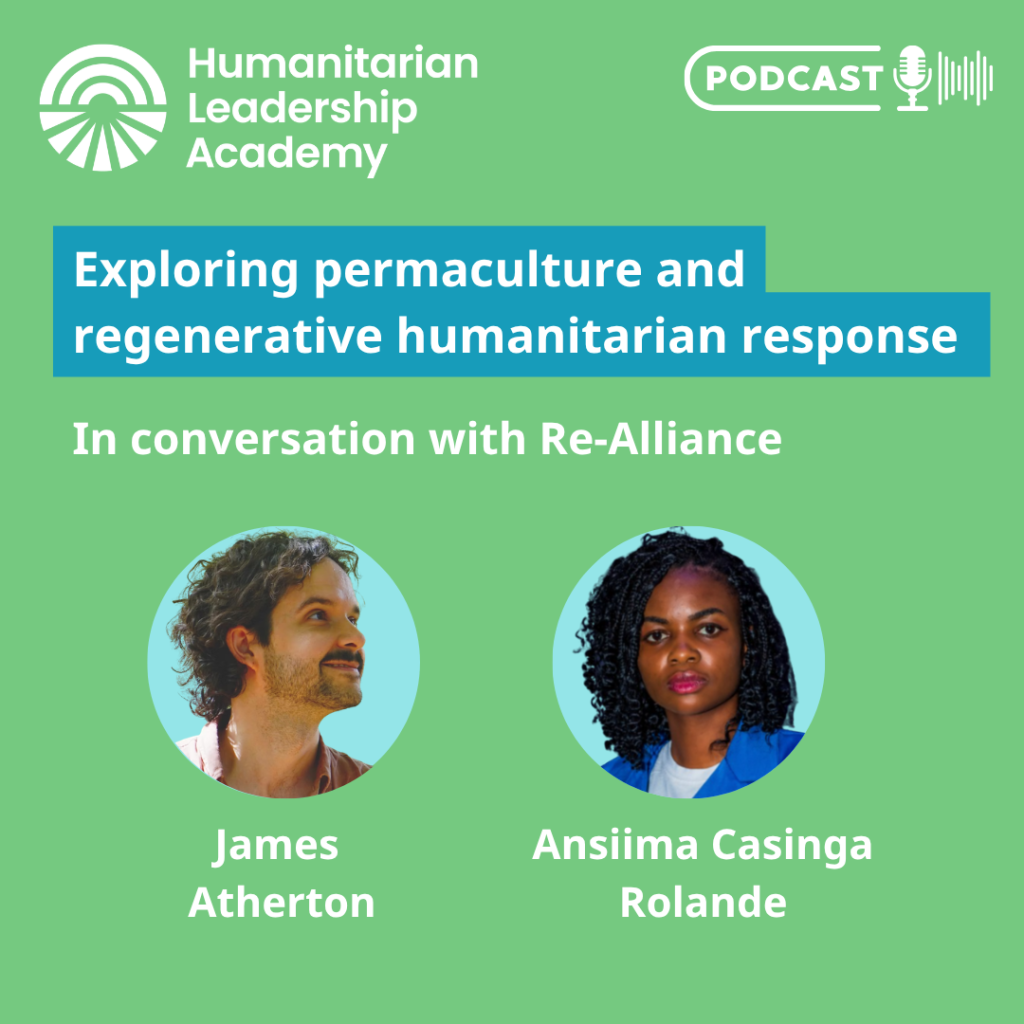
[Voiceover, Fay]: Welcome to Fresh Humanitarian Perspectives, the podcast brought to you by the Humanitarian Leadership Academy.
[Music changes]
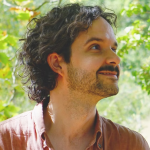
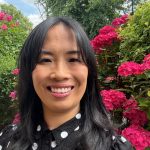
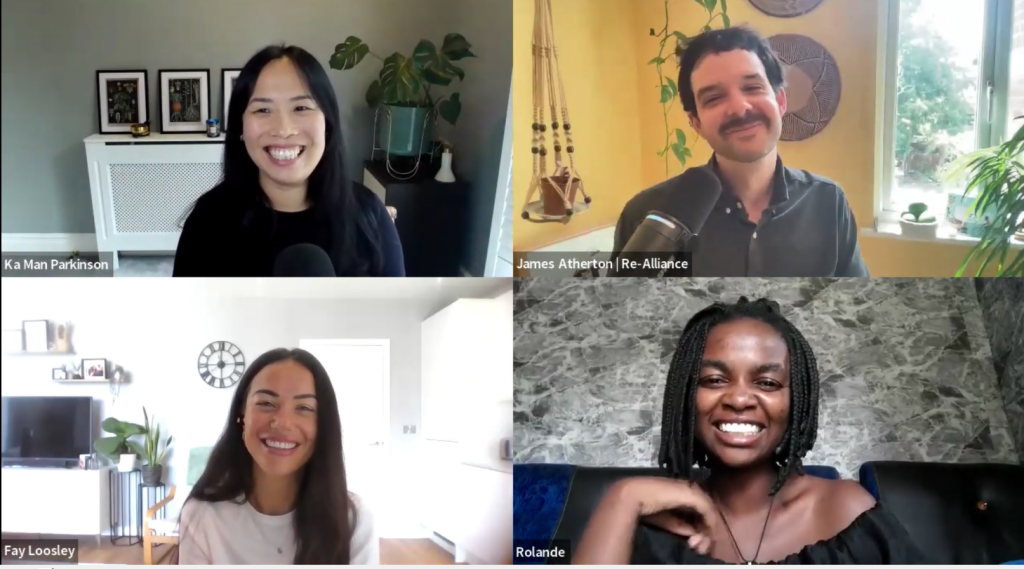
Fay:When we think about humanitarian response, we often think about meeting immediate needs. But what if our work could also help restore ecosystems, strengthen local food systems, and create the conditions for communities to flourish long after a crisis has passed? Well, that’s exactly what we’re discussing today, in today’s podcast episode. My name is Fay Loosley, and I’m the Sales and Accounts Lead here at the HLA. I’m joined by my co-host and colleague, Ka Man Parkinson, our Communications Lead, and we’re delighted to welcome our partners James Atherton and Ansiima Casinga Rolande, also known as Rolande, from Re-Alliance.
Re-Alliance is one of our wonderful Kaya partners. You joined us earlier this year, so a big welcome into the Kaya community, and you’ve launched an amazing new course on our platform. So, for all those listening to this conversation, if you’re intrigued and inspired to learn more, please head over to kayaconnect.org to check it out after this podcast, and we’ll drop the link in the show notes.
We really hope this conversation will resonate with people working at the intersection of humanitarian response, community resilience, food systems, environmental stewardship, and locally led development. But perhaps even more powerfully, it’s a conversation for those who feel that humanitarian work often addresses the symptoms without always having the opportunity to focus on long-term development and sustainable livelihoods.
So, to help us explore these topics, I’d love to start with the people behind that work.
[Music fades]
Fay: So, James and Rolande, thank you so much for joining us today. I’d love to hear a little bit more about your backgrounds, how you came to work at that intersection of humanitarian action and regeneration, and what first drew you to permaculture?
Rolande: Hi, I’m Rolande. I live in Uganda. And now I’m a permaculture trainer. My story is a bit long, but I’m going to try to cut it short.
The way I found myself in permaculture was because I wanted to do something for my community and for my family. My family left Congo and started living in a refugee camp, which was a completely different setting for us — like shifting a whole life. My family, and many other families, faced the same kind of challenges — water, education, food, all the basic needs for people to survive in a refugee camp. And I, as the first child, though I was still young — I was about 15 or 16 at the time — started working to support my family and help my parents raise their younger ones.
So I did a lot of different jobs, until I found one where my role was to collect data from other refugees, new refugees — asking them how they’d been coping with life in the camp over three months, six months, two years. During that time, I kind of discovered a lot, and it opened my eyes to the main challenges that people were facing. I was trying to find a way I could be useful, so I tried to volunteer with some organisations doing that kind of work — but it didn’t work out, I didn’t have any experience.
So I later joined a group of friends with the same mindset — including Morag, an Australian woman who does permaculture. At first I thought I would just go back to my community and teach about food growing [laughs] — that’s what I was hoping to get from it. But it turned out it wasn’t only about food growing. It was like opening a new world that I didn’t know existed but was right there. I learned about education, I learned about economics, I learned about food, I learned about sustainability. I learned so many things, and I realised there are so many conversations that people don’t actually have, but which are right in front of us. And yeah — that’s how I got into permaculture, up to now.
Fay: What an amazing story, Rolande. It’s so great to hear your journey, and how determined you were to build a successful life and thrive and look after your family at the same time, through such hardship. It’s really amazing to hear that, and I’m sure James is extremely happy to have you on his team, being in the heart of that. James, how about you?
James: Oh, thank you, Fay — and thank you, Fay and Ka Man, for having us on the podcast, we’re so happy to be here. And yeah, like you say, Fay, I’m inspired, and I learn so much every day from working with Rolande — thank you, Rolande, for sharing your amazing story, you’re such a wonderful permaculture teacher.
Permaculture, I think for me, started when — I’m from Australia, and my love of being out in wild nature really inspired me to look into how we can learn from living systems, which is kind of what permaculture is — how do we learn from the way life works, the way living systems work, to meet our own needs. That really resonates with what Rolande was saying about how we can meet the challenges we’re facing as humans, but learn from the way nature does it — the way wild nature makes these challenges less burdensome, perhaps. So we often look at this from a perspective of food needs — how do we meet our human food needs in ways that also enrich the ecosystem and support the health of communities and biodiversity.
Rolande mentioned Morag, a permaculture teacher — and actually we found this out much later. I’m not sure Morag even knows this, so maybe I should tell her before this podcast is released [laughs]— but your teacher, Rolande, Morag, lives quite close to where I’m from in Australia, and some of her permaculture projects were my first example of permaculture. Seeing those was what opened my eyes to this amazing movement. So we actually come from similar backgrounds, which is quite interesting and quite funny. And then years later, we met and worked together.
But permaculture, I think, is also quite hopeful, which is what draws me to it. It’s, in a way, a design movement, because it places humans as creatures with this amazing capacity to change the world around us. And it’s true — other species do the same, they change their habitats to suit their needs. But often we see humans doing this in ways that are quite destructive. We’ve changed the planet in such a way that the capacity to sustain life is going down, and we’re creating harm to living systems, which is harming ourselves and humanity too. We’re sadly nowhere near reaching the climate targets we’ve collectively set, and estimates show we’re now seeing effects we were meant to see later in the century. So we’re living in this climate emergency, which can feel very intense.
I mean, Ka Man and Fay, you’ll know that at the time of recording this, we’ve just lived through severe heat waves across Europe, which have sadly and horrifically taken the lives of over 10,000 people in just the past few months alone. So we know we’re living in this intense climate emergency, and we need to make change. But how we do that is where a lot of people have a difference of opinion, and for me, that’s where movements like permaculture can give us a lot of hope — because it places humans as having the capacity to create change in the world around us. We’ve seen us do that in a negative way, but we can create so much positive change too, through ecosystem repair, stewarding biodiversity, and learning from how people have done this since time immemorial — creating better ecosystem health that supports not only us but countless other species.
And when you see, like Rolande was saying, how people who struggled to access water can now access it — because they’re creating landscapes that hold and retain more water in the soil — and how they can then meet their food needs, and people who were struggling to access food now have this abundance — that’s what inspires me about permaculture.
Ka Man: It’s such a pleasure to have this chance to join Fay for this conversation, together with you, James and Rolande. Just listening in already is so inspiring because the fact that you centre this on hope is something that seems in short supply at times, in these current times.
So, you know, you’re talking about this as a movement, based on individuals connecting ideas, and I love the fact that Rolande and James, you were connected via Morag, your permaculture teacher — and that connects your worlds together between Australia and Congo. It’s just incredible, isn’t it. So I’m already enjoying the start of this conversation, thank you so much.
11:41: Chapter 2: Breaking it down: permaculture and regenerative humanitarian response
Ka Man: So James, you already touched on, you introduced us to these concepts briefly on regeneration and permaculture. And admittedly, when Fay told us, oh we have this Kaya partner Re-Alliance and regenerative humanitarian response, I was very intrigued and also thought, oh that’s different — I’ve not really heard about this framed in the context of humanitarian response, within the world that I’m in, within INGO/NGO structures etc. So for our listeners who, like me, are new to this, could I invite both of you to share, dig a bit deeper into these concepts and break them down for us? Could I come to you first, please, Rolande?
Rolande: Yeah, sure. Well, regeneration and permaculture — sometimes I feels hard with these terms and actually dissociate them, especially when I visit people and they tell me, “we practice agroforestry,” “we practice regenerative agriculture,” “we practice this and that” — it’s all under the same umbrella, which is permaculture. Permaculture is, like James said, a system, and a set of principles that help us live in harmony with nature and with ourselves, and to use our resources well. That could be the shortest definition of it. Regeneration, on the other side, is part of permaculture too, but it’s where we learn to go deeper into rebuilding systems that have been broken, and building them stronger than before.
I think permaculture and regeneration are here to teach us that we’ve done a lot of damage as human being, we need to start thinking about how Earth will be in the next 100, 200, or 1,000 years — and it doesn’t look good. Everybody knows that. But how about we start thinking now about solutions that make sure we don’t only support what’s remaining, but build structures that support life in the future, that protect all kinds of life? There are animals that existed when I was born — only 23 years ago — that have already gone extinct. I feel like in 500 years children are going to learn about those animals like we hear about dinosaurs, and that’s not going to look good in the future. Everything in nature has their own role — so when they disappear it’s only going to bring more destruction, even if we don’t directly need them for food or working materials, or clothes or anything. But they contribute to our life, if we think systematically they come somewhere, and they support the system somewhere, that supports us and nature and everything else around us.
So permaculture’s main work how do we make sure we as humans live in harmony with ourselves first — healing the inner self — and then healing the world we live in, making sure the relationships we have with other people, other species, and the resources on this earth are used in ways that support us but don’t harm any part of it, so future generations can also live. James, maybe you can add on that.
James: Well, I just love, Rolande, how you spoke about healing the inner landscape as well — I think that’s so rich. For me, movements like regeneration and permaculture – it’s almost a shift in a way of thinking — a shift in paradigm, a shift in how we see and interact with the world, as well as like you say, learning from nature, which we see as principles: learning how nature cycles nutrients, how it supports life to thrive. It’s almost the three P’s — it’s a paradigm shift, it’s learning the principles, and putting them into practice, right.
What the humanitarian sector can really learn from this is that the paradigm is often about meeting the urgent, immediate need — dealing with emergencies here and now, which saves lives, right, this is why the humanitarian sector does what it does. To save lives. And I guess the invitation from regenerative movements and permaculture is to try to shift this slightly, to build longer-term resilience. So instead of just meeting immediate need, it’s also about building the health and resilience in the long term, like you were saying Rolande. And I do think we can do both. We’ve seen case studies of meeting immediate need — Re-Alliance is a network of humanitarian actors across the globe, and all of our members are putting these paradigms, principles into practice. And we’re seeing how we can meet immediate need. For example, some are working after environmental disasters that have sadly destroyed whole towns and cities with extreme loss of life — so meeting immediate need while also building long-term resilience of place and of community. And we learn from how nature does that to implement that in our strategies. So this is what I think is relevant to the humanitarian sector,
And there are interesting cost-benefit analyses too — if saving lives and healing ecosystems and building resilience isn’t enough on its own, it’s also more cost-effective. So there are conservative estimates that for every dollar invested now in climate resilience, we save at least $10 in the future — and I think it’s actually it’s much, much more than this. Investing now in the resilience of people and communities facing oncoming climate shocks will not only save lives but is a very good investment for the sector now.
Ka Man and Fay, you mentioned the course on the Kaya Connect platform — there are great case studies in the course about how we can bring this to action and what this can look like in a number of humanitarian scenarios. Especially we focus a lot on protracted displacement, but a lot of it can also be applied to immediate need, like natural disasters or post-conflict situations.
19:56: Chapter 3: Building the economic case for regenerative approaches and ‘co-benefits’
Ka Man: That’s so fascinating, thank you both. I’m really interested, James, in the investment point — there’s almost an economic case for regenerative approaches, which is something I’m grappling with a lot in the humanitarian sector generally, given all the funding cuts and shortfalls, and the hyper-prioritisation that we talk of where it is focused on life-saving interventions. So I found that quite interesting that you said actually there are studies around that — I wondered if you would like to just share a bit more? Because I think that is something that would be something not really thought about, that people might think about your approach is a very long-term, slow — in inverted commas — kind of approach.
James: That’s really true — you’re right in that there is an immediate cost challenge for a lot of humanitarian actors right now, because there are massive, immense cuts to budgets, as we all know. And I think that’s interesting from a localisation perspective too, because we’re going to have to focus more on supporting people in place to build their capacities to create change, where humanitarian actors can’t now support because of budget cuts.
But any money spent now does have long-term benefits. And what we notice with regenerative interventions — permaculture practices, whether in the agriculture sector or whether that’s eco-buildings, or climate-resilient homes using natural materials sourced from place — and like Rolande says, often this is much cheaper, because permaculture focuses on using locally available materials, using what’s there, mapping resources to make it cheaper so that people can do these climate resilient actions.
But what we also notice with permaculture and regeneration is that there are so many what we call co-benefits — not just for humans and not sort of just economic benefits in terms of the cost effectiveness of so many of these solutions. But also permaculture interventions have been shown to boost biodiversity by tenfold more — by kind of wild amounts, of wildlife, that was an unintentional pun [laughs]. So many of these benefits are unexpected and not written into the original case for support — such as increases in biodiversity, increases in nature-based livelihoods for communities living in these areas, increasing crop yields from organic and regenerative agricultural interventions. So not only are regenerative interventions often cheaper than conventional approaches, and they carry ongoing monetary and economic benefits going to the future, like economic benefits for local people too.
There are many studies showing these growing, multiple co-benefits over time in regenerative and permaculture interventions. But the fact that it builds resilience to climate shocks in the longer term — I just think it’s a real no-brainer, to be honest [laughs]. We need to be shifting a lot of practices to meet these needs. I think the gap, and why it’s not happening right now, well there are a number of reasons, some of them quite political in a sense that these interventions don’t necessarily fit within a neoliberal capitalist frame, so people feel like they don’t want to invest in these. But it also relies on that, like we were saying earlier, that paradigm shift — supporting local capacity rather than having humanitarian actors come in — which I think the sector is moving toward anyway, toward localisation. I’m happy to see that.
Ka Man: That’s amazing — even in this conversation so far I’m already inspired, and it’s great that James and Rolande are both storytellers, because I feel like that’s the vital ingredient and magic for this paradigm shift, this more holistic understanding, rather than something that’s on the fringes. It’s something that has these – I love that you said “co-benefits” — that speaks to everyone’s language, right. Co-benefits – I was really taken by that, so thank you so much.
25:39: Chapter 4: Growing crises, regenerative response and localisation
So, picking up on some of those points that you’ve made on locally-led humanitarian response and that shift toward working directly with communities — I wonder if you could you could speak more to the context we’re in? You’ve already alluded to the climate crisis, like you’ve said, even in recent weeks, that’s not abstract, it’s affecting lives right now in really terrible ways. And then obviously if we look at the broader global context of ongoing conflict and unmet humanitarian need, it’s obviously a very, very challenging situation. So could you kind of bring in your approaches and kind of overlay your approach onto the localisation agenda and explain why it’s more important than ever? Could we come to you first, please, Rolande?
Rolande: Yeah, sure. As I always tell people when I’m teaching permaculture in a classroom, it’s not that hard a lesson to teach, because people are already living the consequences — so it’s easier for them to understand and pay attention to solutions because it’s already happened to them. Most of the time we hear things from afar, like “10,000 people died,” and it’s just a number — in 30 minutes we’ll hear another piece of news and it won’t feel relevant anymore. But when it’s affected you, you know it’s there. I think that’s why we didn’t act on this at first, until we saw how damaging it is to ourselves and our future generations, until it reached our homes. That’s when we started to wake up — and still, many people don’t believe it.
Localisation in this context is very important, because someone will act depending on what they’ve seen, and someone will heal land they know will serve them back, more than land they’re not sure they’ll ever return to. We’ve seen it a lot. Localisation helps people keep their resources and protect themselves and their land. People are very connected to the land — they don’t leave it when it’s still productive, they don’t leave it when the culture is still going on, they don’t leave it when there is happiness, when families are still coming together. They leave when there’s been a disconnection between them and the land. So it’s not only about being alive, but the interconnectedness of everything happening in the community — the feeling of being alive, really, you know, you can be alive, but feeling alive [laughs] is different from simply existing.
Localisation helps people grow and create a local system — with finances and the resources they have — and to connect with the outer world when needed, rather than depend on it. It creates a sense of dependency on outside help. When you don’t rely on outside help, if it’s not there, you survive on your own. We’ve seen this in Congo during the wars — sometimes there would be like, let’s say, roads would be blocked and there can’t be communication or goods between villages, and the most vulnerable villages were the ones depending on the other villages. That can happen at a continental level too, with exchanges.
So localisation teaches us to be as self-reliant as you can be, to a point where we don’t need much help from outside. We know that humans survived this way for a very long time before depending on outside help. It’s an economy within villages — having our own resources, access to them, and full control over them. There are countries, like Kenya, that have restricted the sharing of seeds, and I don’t understand when and how that kind of law was voted in — it doesn’t make sense to the way humans should live. Localisation uplifts everyone into their own world and their own system and gives everyone a role to play. When you’re sourcing everything at home, everyone has a role, rather than one person controlling everything while everyone else is poor and working for that one power. Everyone helps, and the community relies on each other rather than on outside help. Thank you.
Ka Man: Thank you so much, Rolande. I felt really moved when you said that feeling alive is different from simply existing, and how you spoke about community and that interconnectedness — I thought that was really powerful. Could I come to you, James, could you share your thoughts on this?
James: Thanks — I think Rolande said it all. What came to me as you were speaking, Rolande, is that in permaculture we ground all our work in three core guiding ethics, and they really resonated as you were speaking, Rolande, those were really singing to me: earth care — caring for the earth and living systems; people care — caring for communities and people; and fair share — so that’s kind of equitable distribution. Earth care, people care, and fair share.
Something that really inspired me Rolande, is how communities can come together to support one another in times of crisis — often that can rely on international solidarity, people wanting to support our global friends in need. But the real importance is supporting people in a way that has local autonomy, rather than sending in ideas from the Global North to the Global South — it’s about supporting how people themselves want to act and how people want to respond, in ways that are culturally appropriate and contextual to their land and to their spaces. Because often humanitarian actors from the Global North won’t have any idea about the local landscapes necessarily — so this is why we need localisation, we need people to show us how to respond in ways that is contextual, and does resonate with local people and the land, and is led by local people, rather than having all the power in the Global North. So that’s what really sung to me when you were speaking, Rolande.
I think just now, the humanitarian sector can’t meet the needs of people — not only because of budget cuts, but because over the next few decades we’re going to have tens of millions more displaced people because of climate shocks, let alone the intersecting polycrises of things like conflict, resource deprivation, and economic migration. So many, many more people are going to be displaced and are going to be feeling the effects over the coming decades. And at the moment, the sector can’t meet all these needs, let alone in the future. So we need to be buffering this localisation approach with local talent, local wisdom — really building the capacity of people to be able to respond in times of crisis in ways that are locally relevant, culturally contextual, contextual to the way that the land and the landscape is, so it can meet people’s needs but also ecosystem needs, ongoing. So I think this is why localisation isn’t just important, but really integral to the way we respond going forward.
36:33: Chapter 5: Scaling approaches for long term community resilience and the Re-Alliance Kaya course
Fay: Really interesting — and I think your point with the fact that the growing scale of polycrises around the world, and the fact that the sector can’t continue to meet those needs, and it’s about passing empowerment and leadership on to local people. The question I guess then shifts to: how do we do that at scale, in an accessible way to support communities to have the skills and knowledge to respond in the immediate term but the also build that resilience in the long term?
I think that threads nicely into the course Re-Alliance has recently published on Kaya. I’d love to learn more about it — what initially led you to think a course could be a great way to reach people, and what learning outcomes that anyone listening to takes the course can expect to achieve? James, I don’t know if you want to take that first, since you were part of joining Kaya at the start — and then Rolande, I know you’ve been a big, big part in designing the course too, so I’d love to hear your perspective too afterwards.
James: Thank you so much, Fay. It’s been such a joy to work with you all at the Humanitarian Leadership Academy and Kaya, and the course was a really important moment for the Re-Alliance network — all the wisdom the network has gathered from operating in crisis contexts and implementing permaculture and regeneration has been gifted into this course. We really hope it’s useful for practitioners, not just people from humanitarian INGOs. We especially wanted it to be available for free, which is why Kaya Connect is such an amazing platform — it’s openly accessible to so many people.
We wanted it available for free also for community responders— people operating on the ground, such a silly term as we’re all ‘on the ground’, I hope, unless we’re in space! Some of us are, I guess! [laughs] But people who are operating in crisis contexts trying to meet their community’s needs while also building ecosystem health. We wanted the course to be just an introduction, to get people excited about learning from living systems — permaculture, regeneration, agroforestry, agroecology — and thousands and thousands of years of wisdom from people who’ve been doing this work, like Indigenous and land-based communities.
This is really just a taster course for now — we’re hoping of course, and Fay and Ka Man, you’ll know this, there will be more courses soon, a little spoiler there [laughs]. But we wanted it to really speak to people’s hearts and give them real skills to be able to learn more, because wherever listeners are in the world, there will be amazing permaculture teachers near to you who can help contextualise some of this information into your localities. Once you’ve done the course — it’s about two hours online — you get a fantastic certificate you can show your friends and post on LinkedIn – and remember to give us five stars on the course, you know [laughs], if you want, please! We hope you can use that certificate to show you’ve started your learning journey, and continue it with local permaculture teachers, or by bringing a permaculture teacher into your organisation if you’re with an INGO, to help embed this into the policies and practices in INGOs. We hope this course can be a seed for planting these ideas in you and your colleagues.
Rolande: Actually, the first time I met James, it was for a video recording — he just asked me to shoot a video, was it about sustainability or something, I don’t even remember [laughs]. I did a video and sent it to James and we didn’t talk again after that. Then one day I was scrolling through my emails and got another one saying there was a course going to be recorded and published, and I thought, okay, this is the first time [laughs].
And I was happy, and when I personally read the script it was very exciting, partly because it connected with my own journey into permaculture — we always say “nothing for us without us,” because a lot of the time organisations use refugees not as people who need support but as bait for funds, or something. It happens, it’s so sad, it’s so sad — some people just throw the word “refugee” a few times into a few sentences, and it’s not really about the people they’re working for. It happens a lot. And it connects to my job where I was collecting data — and it didn’t feel right to be the person who goes to the community and I felt like, it in some ways, not dehumanising, but it felt like I wasn’t having real impact on the people I was doing this with. That’s why I shifted from doing it for money to actually working together with communities, to help build something for them. Learning about sustainability and regeneration gave me that same feeling that inspired me do this— like, this is another level: how do we make it stronger, how do we learn to actually build systems that not only heal what’s been destroyed but also build stronger ones that will not only sustain people but also preserve resources for future generations that will teach people about everything around them and how do we do this for ourselves, and what comes from somewhere.
So yeah, I was really excited to do the course. What I hope for people who come across this course is that they feel that connection too — I tried my best [laughs] to convey the emotion alongside the words, and I hope it is inspiring for them, and is something that inspires them to do better, and gives them a good beginning to actually dig deeper into this other world. When I talk about permaculture, I feel it’s a different kind of system that we were never taught about in school — we lived a part of it, but nobody told us there was another option than the main design system of how life should be. I really hope this course gives people a good introduction to digging deeper and discovering all the gold down there [laughs]. Yeah!
James: Also, just to say — we’re so lucky to have Rolande on the course. She’s an internationally renowned permaculture teacher, and teaching alongside her was such an honour for me. So, Rolande, thank you for doing the course — I know everybody’s inspired by you. Thank you.
Fay: We feel very honoured that you’ve chosen Kaya to publish that course, and as James mentioned, everybody who wants to access it can do so for free — that’s part of our mission, to help communities and people around the world access the tools and resources they need. I think lots of people listening will find this exciting and will enrol in the course to learn more about permaculture.
47:30: Chapter 6: A magic wand: Rolande and James’ wishes for regenerative humanitarian response
Fay: I could listen to you both all day — it’s so inspiring, so exciting, I love hearing about this world and the sustainability aspect of it. I think there are so many exciting things you guys want to achieve, so many long-term goals. If we can try and condense that — if you had a magic wand, what would your wish be for the humanitarian sector through that regenerative lens?
Rolande: Well, this is not a hard question, but there’s just a lot — which one would I choose? Probably, I would restrict the negativity toward regeneration. As an example — we’re doing this work, we’re the good guys here, but we know there are systems, big systems, very wealthy systems that have been built, and continue to grow, against everything we’re doing. So if I had a magic wand, what I would do is not destroy them, but I’d turn them toward doing things sustainably. I know many big companies talk about sustainability, but the actions, the products on the market, and the profit they want to make don’t reflect what they claim they do. So I’d turn every system built against our work toward doing the sustainable work [laughs]. Yeah.
I think that would help far more than — it’s okay to work locally, it’s okay for people to create their own local systems, but sometimes it feels like shifting the burden onto local people for problems that are global, caused by societies these local people barely contributed to. There have been studies showing that the people working hardest to rebuild these systems are not the people who destroyed them, and that in some ways, that doesn’t feel right. It’s the only option available to them right now — most of times, it’s poor people, who have a lot of other things to worry about, working hard to rebuild because it’s all they have. Everyone else can buy just another plot in a cleaner environment, somebody else can buy a fan or whatever resources they need to transform the air in their houses, anyone can travel wherever they want. But local communities that don’t have these, that access, they don’t have money to buy things to make life easier for them, are the ones healing wounds created by people who can actually run away from their mistakes anytime, anywhere. Yeah, sometimes it feels unfair. Yeah — sometimes it feels unfair. Yeah.
James: I so agree, Rolande — thank you for pointing that out, because most of the harm is created by the Global North, and yet it’s mostly people in the Global South feeling the worst effects of the climate crisis. It’s so unfair.
We talk about the difference between sustainability and regeneration — I like to think of sustainability as interventions that minimise or stop harm, and regeneration we think of as going a bit deeper, creating more capacity to sustain life and abundance. They’re different, in a way, but sometimes to achieve regeneration we also have to look at sustainability initiatives to stop harm — and this is exactly one of those moments of harm, like you say, Rolande, where so much of industry, decision-making, and money in the Global North is going toward creating destruction that mostly affects people in the Global South, and the harshest effects there.
So if I had a magic wand, we’d have to stop that first of all — rethink the way our societies and economies work so they’re not focused on creating harm to people and planet, but refocused, as we were saying, toward creating more space for health, life, and abundance, learning from nature and living systems. And I’d also say to policymakers and decision-makers within humanitarian INGOs and agencies: go take this course on Kaya, and then go on a Permaculture Design Certificate course — a two-week course taught by a local permaculture practitioner, wherever you are in the world. Find a PDC, a permaculture design certification. Because people come to permaculture thinking it’s about gardening, right, and it’s so much more than that — it’s a whole new way of thinking, a revolution in how you approach agriculture, but also how we build our houses, how we travel, how we live our lives. So if I waved a magic wand, it would be a paradigm shift in how we think in relation to the living world, and then filter that into the policies and practices into the agencies or organisations that we work within.
55:00: Chapter 7: Closing reflections
Fay: Yeah, I mean they are very, very big, important topics that are extremely relevant in today’s world.
So, I suppose just to close off really, we’ve spoken about some really interesting, inspiring, empowering things, and I’d love to sort of just get some closing remarks from you all. I think for me, I’ve learned that permaculture is so much more than what a lot of people assume — it’s about regenerating land and rebuilding resilient local systems and communities. But I think one thing that really touched me in this conversation is the piece about creating hope for future generations — for me that’s the sustainability piece that really touched me. It’s that hope piece. And also the fact that when we provide local communities with that empowerment to lead and build these resilient systems and sustainable communities, it gives them that stake in the game, that skin in the game, I think that’s what inspires and gives them that passion to fight the good fight and have that stake in the future we create. So that’s some of my takeaways — thank you both so much for sharing your thoughts today and telling us more about the course and Kaya. So I’d love to invite you all to share your closing remarks, and thank you again for joining us on a lovely Friday morning.
Ka Man: Thank you so much, Fay, and thank you, James and Rolande, for the privilege of this conversation — I’ve felt incredibly grounded, inspired, and there’s also very sharp reminders as well in what you’ve shared. Do you know, I came into this talking to you about, before we started recording, about soil, “oh I’m really interested in soil, let’s have lots of soil conversations at a later date!” [laughs] and I still want to have those conversations — but you’ve really spoke to how, you know, we bandy this word “holistic” around a lot, but it really is, you’ve really put this into the frame of everything we do. You’re talking about regenerative approaches, and I think it’s about us as humans as well, right— reminding ourselves what it means to be human, in support of assisting other humans. Returning to what Rolande said about doing no harm — obviously that’s the central tenet of humanitarian work, but as a sector we have to take a long, hard look at where our structures and systems have caused harm, and continue to do so, and what we can do, proactively do, to mitigate that as we rebuild the sector and repair these relationships and links with communities.
It’s been so inspiring to hear you speak so candidly, and I’m definitely going to take the Kaya course, I definitely want to check that out and I really think everyone should do that too. So, thank you, really. So now I’d like to come to our wonderful guests. Rolande, would you like to share any closing reflections?
Rolande: Oh, thank you so much. I’m always happy to have conversations like this, because I always say, I’m not the most amazing person out here, but I have the chance to speak, I have the chance to share in the names of other people I’m representing now, and I’m so happy that I’m sharing our story, and getting it out there. I’m so happy my words can help make a difference in the world beyond, like what I can do with my hands. I’m always happy for you and other people offering platforms like this and putting us there — because sometimes living in a camp it really feels like being taken away from the real world. And I’m so happy about everything we’ve spoken about.
The main point of today was how we live in harmony with nature and the people, which is the core of permaculture. And I hope many people take the course, and remember it’s just a starting point — go deeper, open up to this new discovery, it’s very big, we can’t talk about it all in one day. I’d really love to talk more, different subjects, and I also I love to learn a lot — I’m sure I’ve learned a lot today too. Thank you.
Ka Man: Thank you so much. James, can we bring you in for some closing reflections?
James: Thank you so much, Ka Man, Fay, and Rolande — it’s been such a joy to share this space with you, and I’ve come away with so much learning and also so much hope, like Fay has said. We’re living in a polycrisis of intersecting crises. Humans have this amazing capacity to change the world we’re part of, I should reframe as, so we can make change, and we need rapid change now.
So, I say to everyone listening: allow yourself to be changed too, by movements like permaculture and regeneration. Do the learning, share it with your colleagues and friends, because we need this hope, we need change, and we need to create space for the life that sustains us on this planet to flourish alongside us — not just humans, but all the other species we share life with, all the other species to thrive as well. Thank you so much for giving us space to share this, and I really hope listeners enjoy the Re-Alliance course.
Ka Man: Thank you so much — what an absolute pleasure. Fay and I have absolutely just, it’s been such a joy to spend this time with you, so thank you so much. So Rolande, James, Fay — thank you for being here for today’s episode of Fresh Humanitarian Perspectives from the Humanitarian Leadership Academy.
[Music]