The Humanitarian Leadership Academy and Data Friendly Space are excited to announce the launch of a new microlearning on the ethical use of artificial intelligence (AI) in humanitarian work, developed with and for humanitarian practitioners.
The free microlearning module Ethical AI use and decision-making in humanitarian work is available on the HLA’s digital learning platform Kaya, alongside a companion guide. These resources have been developed in response to the clear demand for AI literacy opportunities signalled in our global joint research into how humanitarians are using AI.
Addressing the need for practical humanitarian AI guidance
The microlearning is part of a collection of resources from the joint HLA-DFS 2025-26 research initiative and supporting campaign, representing the world’s first study to map and track how global humanitarian practitioners are using AI in their work, spanning 140+ countries.
With 75% of survey respondents telling us that they use AI tools regularly to support their work, while the organisational approach is still emerging, the key question practitioners are asking in 2026 is: “how can I use AI safely and responsibly in my work?”
In response, we have developed the new microlearning, designed with practitioner needs in mind who need to apply learning as the technology and its capabilities develop at pace. The practical learning has been shaped and tested by humanitarians at the heart of our humanitarian AI research community, whose feedback helped ensure it reflects scenarios and decisions humanitarians using AI tools may navigate through their work, often in high-pressure and complex situations.
Flexible learning approach designed for real world needs
The starting point for the learning is a microlearning guide to introduce key ethical principles for humanitarian AI use – including data minimisation, human-in-the-loop oversight, representational bias in data, and allocative harm.
The guide is a short PDF that can be saved, shared, and viewed offline on a phone, as we know that humanitarians often work and learn on-the-go, sometimes with intermittent internet access.
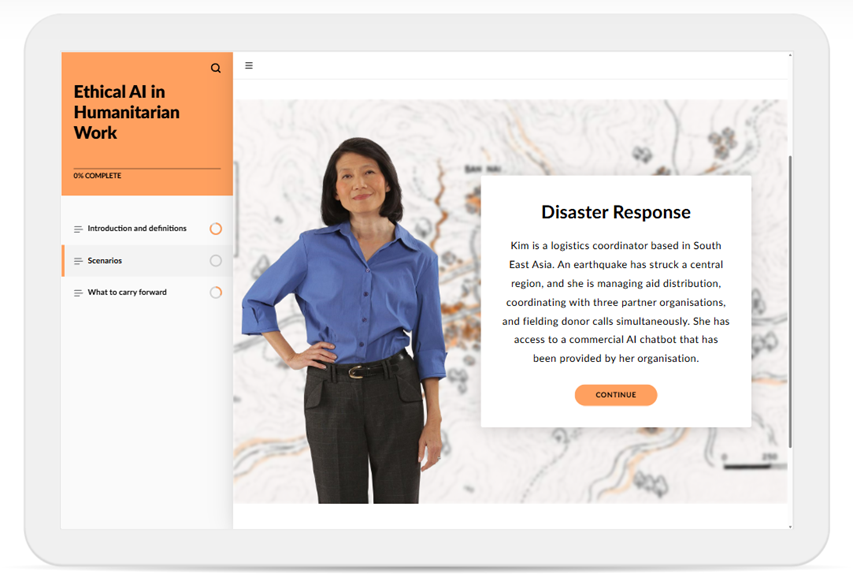
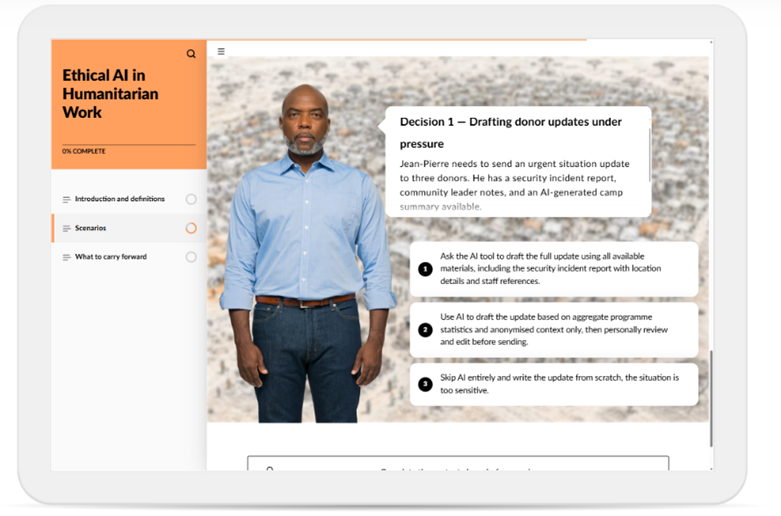
For learners who want to deepen their understanding, the 30-minute interactive Kaya module takes learners through short scenarios designed to highlight key principles and support decision-making, particularly when working under pressure.
Reflection prompts at the end of each scenario invite practitioners to apply the learning to their own context and start conversations on responsible AI use within their teams to support wider organisational adoption.
Practitioners who helped to shape the course development emphasised the contextualised, interactive aspects of the learning:
“This is a great and much needed microlearning course!”
“The Kaya learning is smooth, and easy to use with strong examples and case studies.”
“I think the course is strong, timely, and highly relevant for humanitarian practitioners, especially given the rapid and often unstructured adoption of AI tools across the sector. The scenario-based approach makes the content practical and relatable.”
“The reflection prompts are useful and help learners connect the content to their own operational realities. This makes the module more engaging and discussion-oriented rather than purely instructional.”
“This is one of the best humanitarian learning resources I have seen on the subject, and I believe it will make a meaningful impact by promoting responsible, ethical, and people-centred use of AI in humanitarian work.”
Ka Man Parkinson, Communications Lead at the Humanitarian Leadership Academy said:
“This microlearning Kaya module and companion guide has been made possible thanks to practitioners telling us what they need through our joint research and community engagement initiatives over the past 12 months. We’re excited to join forces with Data Friendly Space to harness our shared expertise and networks to co-create humanitarian AI learning resources with and for humanitarian practitioners.”
Phil Street, Digital Learning Project Lead at the Humanitarian Leadership Academy added:
“It was fantastic to collaborate on this course, blending partner and humanitarian practitioner expertise together with instructional design on the Kaya platform, to co-design impactful content for learners in the high-demand topic of humanitarian AI that is grounded in operational realities.”
Madigan Johnson, Head of Communications at Data Friendly Space said:
“The people we work with aren’t abstract users, they’re humanitarians making hard calls in impossible situations, often exhausted and under-resourced. When they pick up an AI tool to help them cope with that, the last thing they need is a lecture. They need honest, practical guidance that respects their intelligence and their context. We have been so grateful for the community and the Humanitarian Leadership Academy to be able to build this with them.”
Meeting the moment: an opportunity to scale humanitarian AI literacy
During the Kaya module review and testing process, humanitarian practitioners remarked on the practical focus, and provided feedback to help shape the products, as well as highlighting future potential for further developments. The HLA and DFS welcome engagement from organisations and funders who share this aspiration to support this critical area of humanitarian AI literacy and skilling.
Ka Man Parkinson said:
“The evidence shows the significant sector demand for this kind of practical, contextualised guidance. Thanks to this collaboration, the foundations are in place to expand this offer so it reaches humanitarians where they are – in their own languages, contexts, and stage of their AI journey. Unlocking resources and support will enable us to develop this portfolio further – including versions in more languages, additional scenarios and levels, and integration with organisational learning. We hope that humanitarians will enjoy this microlearning course – we encourage learners to share feedback and their Kaya certificates online to inspire the wider community!”
Madigan Johnson said:
“Every piece of feedback we got during testing came from someone doing this work for real. That shaped everything. This resource belongs to them, and we need donors to understand that supporting this sort of learning enables more high-quality responses during crises.”
Acknowledgements
The HLA and DFS would like to thank everyone who has made this microlearning possible through in-kind and pro bono support, including subject matter experts and reviewers Musaab Abdalhadi (Sudan), Ali Al Mokdad (Denmark), Nour Arab (Lebanon), Timi Olagunju (Nigeria), and Ivan Toga (Uganda/DRC), and the wider community of humanitarians who have shaped this work through surveys, webinars, podcasts, interviews and conversations across this research and engagement initiative.
About the research
In May 2025, the Humanitarian Leadership Academy and Data Friendly Space launched a joint study on artificial intelligence (AI) in the humanitarian sector, representing the first global baseline study into humanitarian AI adoption. This research continued in January 2026 through a pulse survey to track shifts in adoption and attitudes towards AI in humanitarian work. A combined total of more than 4,200 responses have been received across the two survey waves.
Since the release of the foundational study, the research has achieved significant global reach and impact: informing academic research in Türkiye, Colombia, Switzerland, and Germany; supporting an Arabic-language AI training initiative for local responders in Sudan; contributing to civil society advocacy in Ukraine; and shaping high-level and practitioner dialogue on responsible humanitarian AI at international conferences and webinars, as well as through a six-part podcast series with a focus on global and African humanitarian AI perspectives, and microlearning guides. All reports and briefing notes are available on the research landing page in English, French and Spanish.
This research and the resources it has generated, including this microlearning, have been conducted and developed by the HLA and DFS without external funding.
Contact
Humanitarian Leadership Academy
info@humanitarian.academy
Data Friendly Space
hello@datafriendlyspace.org
Related News

75% of humanitarians now use AI regularly – yet fewer than one in ten work in an organisation where AI is widely integrated
19th March 2026
Tracking trends in humanitarian AI adoption: launch of January 2026 pulse survey
12th January 2026

The humanitarian sector’s AI paradox: individual adoption outpaces organizational infrastructure
15th July 2025