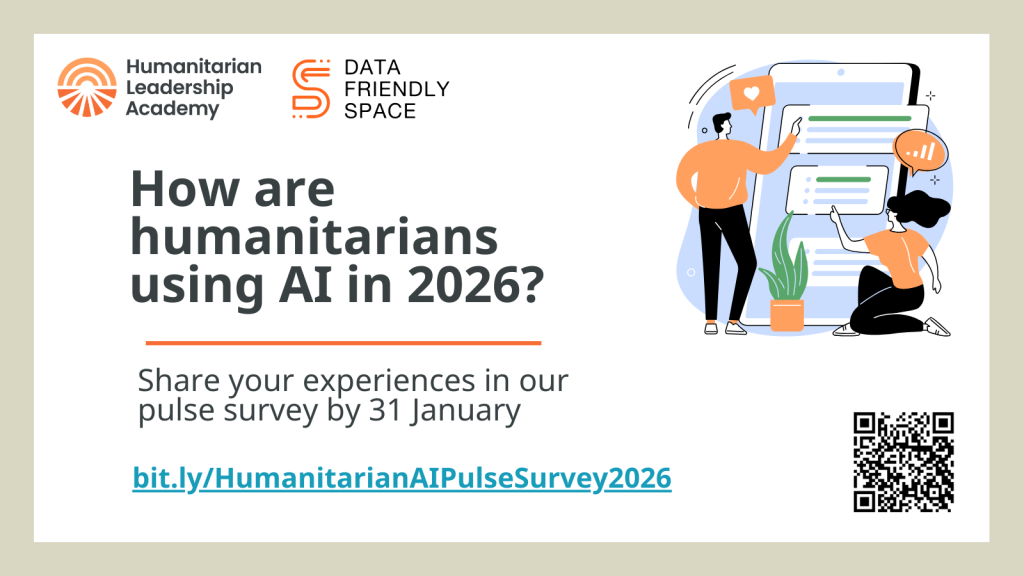
The Humanitarian Leadership Academy and Data Friendly Space have launched a pulse survey to track the evolving relationship between humanitarians and artificial intelligence (AI).
Building on our 2025 global foundational study
In May-June 2025, we asked humanitarians how they were using AI, and the results revealed what we called the ‘humanitarian AI paradox’: widespread individual adoption outpacing organisational readiness, with 93% of humanitarians using AI tools but only 8% working in organisations with fully integrated AI strategies.
Now, six months later, we’re checking back in to track any shifts across the sector through a short pulse survey to understand if and how the humanitarian sector’s relationship with AI has evolved since our comprehensive research in mid-2025, and to track our journey together.
Why this matters now
In the months since our initial research captured insights from 2,539 humanitarians across 144 countries, the sector has continued navigating funding cuts, operational pressures, and the rapid evolution of AI capabilities.
Our original research identified five critical challenges: the gap between individual adoption and organisational readiness, the AI skills paradox, fragmented training approaches, governance gaps, and heavy reliance on commercial tools. But we also found something powerful, that humanitarian workers demonstrate remarkable adaptability and innovation, often ahead of their organisations’ formal strategies.
The question now is: what’s changed?
Have organisations begun closing the implementation gap? Are training programs keeping pace with demand? Has the governance vacuum started filling? Are purpose-built humanitarian solutions gaining ground against commercial platforms? Most importantly, how has the humanitarian experience with AI shifted day-to-day?
The collaboration between DFS and HLA brings together complementary strengths, focusing not just on collecting this data but on continuing conversations and building a community-driven understanding of how AI can serve humanitarian work while maintaining the core principles of humanity, neutrality, impartiality, and independence.
Our original research worked precisely because it centered on community participation. We heard from local NGOs innovating with limited resources, from UN agency staff navigating institutional processes, and from individuals experimenting with AI to better serve crisis-affected populations. Humanitarian voices revealed both the promise and the complexity of AI in humanitarian contexts.
What this pulse survey aims to reveal
This follow-up survey is designed to capture a timely snapshot of progress and persistent challenges. Are the 73% of humanitarians who identified training as a top priority now getting the support they need? Have the organisations that were “experimenting” moved toward integration? Are ethical guidelines becoming more common?
We’re particularly interested in understanding whether the patterns we observed, such as the strong engagement from Sub-Saharan Africa and the prevalence of self-directed learning, are deepening or shifting. These insights will help the sector understand whether current approaches are working and where collective action is most needed.
The results will provide humanitarians, organisations, donors, technology partners, and policymakers with a key snapshot of where we currently stand months later, where shifts have occurred, and whether AI is being integrated at a larger scale than the previous research showed. As our original research demonstrated, the most valuable insights come directly from humanitarian practitioners who are experimenting, adapting, and applying AI tools to serve communities.
Madigan Johnson, Head of Communications at Data Friendly Space, said:
“Six months ago, we uncovered a striking paradox: humanitarian workers were racing ahead with AI adoption while their organisations struggled to keep pace. Now we’re asking, has that gap narrowed? The sector’s response to our original research was remarkable, and this pulse survey gives us a chance to measure if this is being translated into action. The humanitarian community showed up powerfully last time, and we need that same energy now to understand how we’re collectively moving in terms of AI.”
Ka Man Parkinson, Communications and Marketing Lead at the Humanitarian Leadership Academy said:
“We were highly encouraged by the global engagement with our 2025 humanitarian AI survey, which helped to drive sector-wide dialogue. As organisations plan for 2026, we invite humanitarians to help us build an updated picture of how the field is evolving through this pulse survey, providing data and insights to support informed decision-making in this rapidly changing landscape.”
Take the pulse survey by 31 January 2026 and help us understand how the humanitarian sector’s relationship with AI is evolving. Your 5 minutes will help build a more informed, coordinated, and responsible approach to AI in humanitarian action. The survey is available in English, with automatic machine translation for Arabic, French, Polish, Portuguese, Spanish, Turkish, and Ukrainian (based on browser settings). Thank you for your support.
Access the survey: https://bit.ly/HumanitarianAIPulseSurvey2026
We will share findings with the sector from February 2026. Follow HLA and DFS channels for updates!
Listen to a survey launch podcast
Tune in to a new Fresh Humanitarian Perspectives podcast conversation between the project co-leads to learn more about this research.
How are humanitarians using AI in 2026? Launching the next phase of our research
Contact
Email info@humanitarian.academy or hello@datafriendlyspace.org
Related News

75% of humanitarians now use AI regularly – yet fewer than one in ten work in an organisation where AI is widely integrated
19th March 2026
The humanitarian sector’s AI paradox: individual adoption outpaces organizational infrastructure
15th July 2025
The HLA and Data Friendly Space launch landmark survey on AI in the humanitarian sector
28th May 2025