29th June 2026
In the context of challenges facing children and communities affected by crisis; investing in development, education, and peacebuilding is ultimately far less costly than paying the price of wars, conflicts, and their long-term consequences.
Gaza continues to face an unprecedented humanitarian crisis characterised by widespread displacement, large-scale destruction of civilian infrastructure, severe restrictions on access to essential services, and escalating protection concerns. The prolonged conflict has placed immense pressure on humanitarian actors, communities, and local institutions alike.
This acute emergency comes on top of a chronic and protracted crisis marked by weakened systems across multiple sectors, including healthcare, education, water and sanitation, electricity, and humanitarian service delivery. Years of recurrent shocks have significantly eroded communities’ coping capacities and institutional resilience.
Approximately two million people are struggling to access adequate shelter, food, clean water, healthcare, education, and psychosocial support. At the same time, humanitarian workers continue operating under extremely challenging circumstances, striving to respond to ever-growing needs despite limited resources, insecurity, and severe access constraints.
Despite these immense challenges, local communities and humanitarian actors continue to demonstrate remarkable resilience, solidarity, and commitment to supporting those affected.
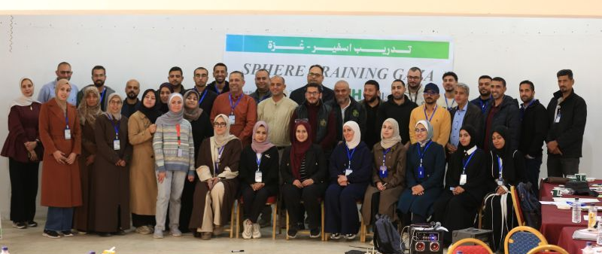
Earlier this year in support of these humanitarian actors, Humanitarian Leadership Academy (HLA), Save the Children, Centre for Humanitarian Impact CHI, and Sphere collaborated to design a Sphere programme specifically for humanitarians in Gaza responding to the crisis.
The Introductory Training to Sphere Standards is aimed to strengthen the quality and accountability of humanitarian response and increase sustainable local capacity particularly under the devastating conditions currently facing Gaza. Two cohorts have been concluded with a planned third cohort starting on June 30 and Training of Trainers (ToT) in the near future.
The training was designed to improve participants’ ability to apply humanitarian standards in their daily work such as in areas covering water, sanitation, shelter, health, and food security. The goal is higher quality response, accountability, and dignity for people affected by crises and organisations that deliver principled and effective humanitarian assistance.
In Gaza, Mahmoud H. Abudraz works as a humanitarian professional and led on the delivery of the Introduction to Sphere Standards training.
“A valuable platform for humanitarian practitioners”
Sixty-five humanitarians have been trained so far with overwhelmingly positive feedback. While the training focused on the Sphere Humanitarian Charter, the Protection Principles, the Core Humanitarian Standard (CHS) Commitments, and the Sphere Minimum Standards across humanitarian sectors; the Humanitarian Charter and the Protection Principles generated particularly strong engagement, as they resonate deeply with the realities experienced by both humanitarian workers and affected communities in Gaza.
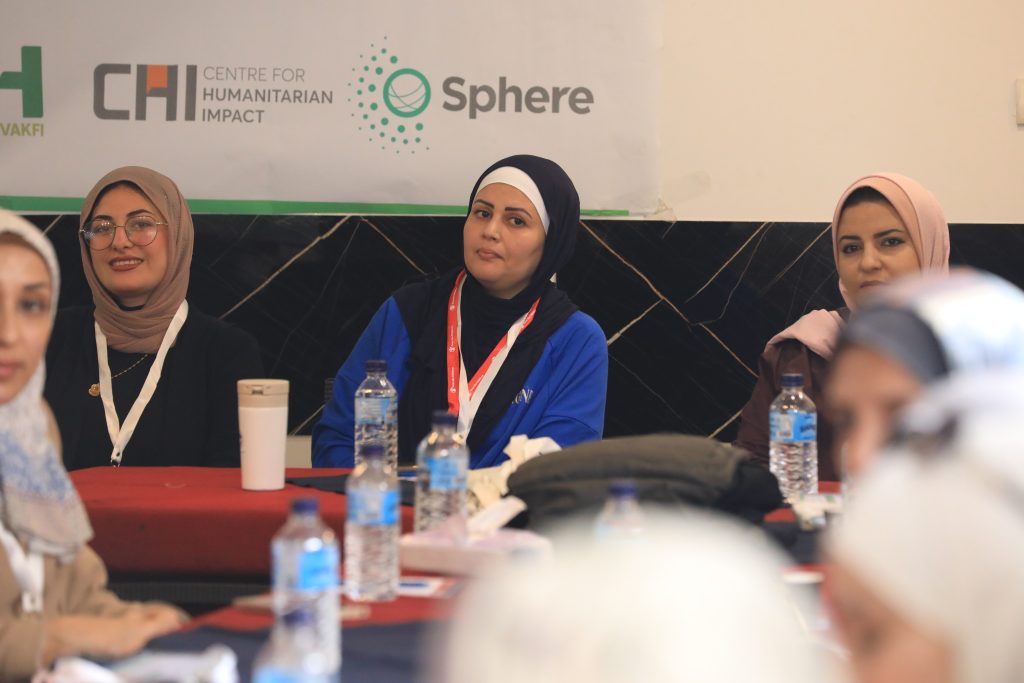
Several attendees shared that the training helped them better understand how humanitarian standards can be translated into practical actions within the complex realities of Gaza. Interactive discussions, case studies, and contextualised examples enabled participants to connect the standards directly to the operational challenges they encounter every day. The training has also provided a valuable platform for humanitarian practitioners from different sectors to exchange experiences and learn from one another.
This peer-to-peer learning has been one of the programme’s greatest strengths.”
An important message that has run throughout the training is that standards are not merely figures and numerical indicators. At their core, they are about dignity, quality, accountability, and the rights of affected populations. While the humanitarian context in Gaza often makes it difficult to fully achieve these standards, this should not lead us to redefine or lower them. Rather, the standards should remain a benchmark that guides our efforts, highlights existing gaps, and reinforces our commitment to quality humanitarian action.
The programme participants are from a diverse range of local and international humanitarian organisations operating across Gaza including programme managers, project officers, protection specialists, MHPSS practitioners, shelter and WASH professionals, monitoring and evaluation officers, and emergency response personnel.
This diversity has greatly enriched the learning experience, as participants bring perspectives from different sectors and operational contexts including experiences from the frontline of the response, communities affected by displacement, insecurity, and protection risks.
Their commitment to professional development despite extremely challenging circumstances reflects the dedication, professionalism, and resilience of Gaza’s humanitarian workforce.
The (Sphere) standards should remain a benchmark that guides our efforts, highlights existing gaps, and reinforces our commitment to quality humanitarian action.”
Sixty-five humanitarians have been trained so far with overwhelmingly positive feedback
Investing in development, education, and peacebuilding is ultimately far less costly than paying the price of wars, conflicts, and their long-term consequences.”
Participant reflections
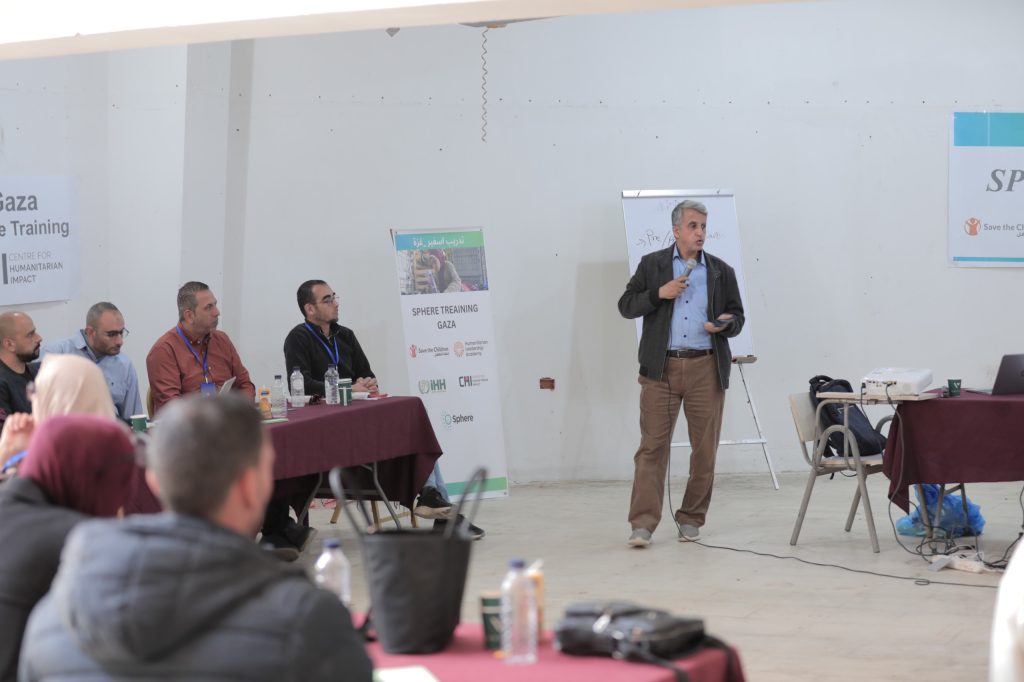
My interactions with participants revealed one of the most common reflections shared – that the training helped them view humanitarian standards not as theoretical guidelines, but as practical tools that can improve decision-making, programme quality, and accountability.
Several shared that the training deepened their understanding of accountability to affected populations and reinforced the importance of placing dignity, participation, and inclusion at the centre of humanitarian action. Discussions around balancing humanitarian principles with operational realities were especially meaningful and led to rich exchanges among participants.
Many participants also highlighted the value of learning alongside colleagues from different sectors and organisations, which strengthened collaboration, mutual understanding, and peer support.
An important reflection that emerged was the recognition that, although humanitarian actors in Gaza are often unable to fully meet the standards because of severe operational constraints. In such scenarios, the standards should still serve as a tool for advocacy and reporting. This will help humanitarian workers identify and communicate gaps, raise red flags against the normalisation of substandard conditions, and advocate for the resources and access necessary to uphold people’s rights and dignity.
Another area that stood out was the contextualisation of standards. Participants were eager to explore how global humanitarian standards could be applied effectively within the unique and complex context of Gaza without compromising their fundamental intent and purpose.
A commitment to learning
Humanitarian crises do not diminish the need for capacity strengthening; they make it even more essential. During emergencies, humanitarian workers are often required to make critical decisions that directly affect the lives, dignity, and well-being of affected populations. Training helps ensure that these decisions are informed by humanitarian principles, recognised standards, and good practice.
Investing in the capacity of local humanitarian actors is particularly important because they are often the first responders and remain present long after international attention shifts elsewhere. Strengthening their knowledge and skills contributes to more effective, accountable, and sustainable humanitarian action.
The experience of delivering Sphere training in Gaza demonstrates that even amid conflict, uncertainty, and profound hardship, humanitarian professionals remain committed to learning, improving, and serving their communities. This commitment is a powerful reminder that quality humanitarian action begins with investing in people. By strengthening those who serve others, we ultimately strengthen the humanitarian response itself.