24th October 2026
“You cannot expect a child to attend school, or even a temporary learning centre, whilst they are hungry.”
In the latest episode of the Arabic-language podcast series Local leadership in humanitarian action: Voices from Palestine, the HLA’s Huseyin Arslan speaks with Ibrahim Abu Sobeih, Programme Director and Humanitarian Operations Advisor at Save Youth Future Society, a local Palestinian organisation based in Gaza.
Drawing on years of humanitarian work in Gaza, Ibrahim argues that after three years of conflict, education has to be rebuilt alongside everything else children need: food, safety, health and hope.
Three years that reshaped childhood
“The people of Palestine value and cherish education,” Ibrahim says. That is what makes the scale of the loss so stark.
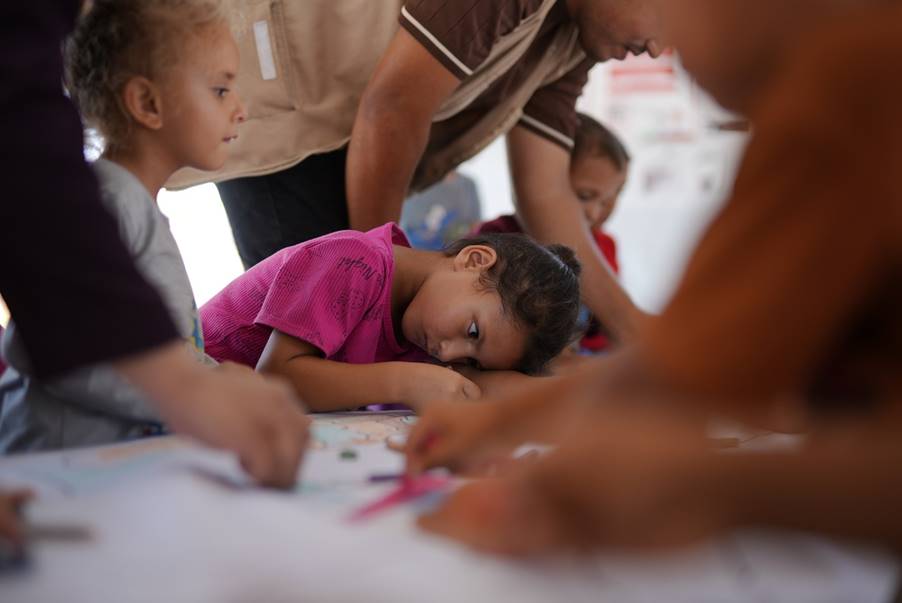
In Gaza, almost an entire generation has been cut off from formal schooling for nearly three years. Most school buildings have been damaged or destroyed, and many of those still standing now shelter displaced families. Temporary learning spaces have kept learning alive, but they are no substitute for school: a child who was in third grade when the war began cannot simply pick up the sixth-grade curriculum.
The damage goes deeper than buildings and lost lessons. Children have been displaced again and again, and many have lost parents or siblings. Some boys have taken on dangerous work to support their families, while girls face growing risks, including early marriage. For many, Ibrahim suggests, childhood itself has been cut short.
“It is not just a crisis of school buildings; it is a crisis of access. It is a crisis of safety, quality and continuity. It is a crisis of mental health.”
In the West Bank, the crisis takes a different form, as movement restrictions and violence keep children from safe, continuous schooling. If no systematic solution is found, Ibrahim warns, “we will lose a generation.”
A response for the whole child
For Ibrahim, the central lesson is that “education cannot take place in isolation from food, health, protection, water and sanitation”. Malnutrition in early childhood, he warns, will follow children into the classroom for years.
So his team combines teaching with psychosocial support and learning through play, without losing sight of the basics. “Children need to feel safe, to play and to interact, but they also need to read, write, do maths and return to a clear educational routine.” Sessions for parents help them cope with stress and spot signs of distress.
Teachers need the same care. “Teachers are not people living far removed from the conflict,” Ibrahim says. “They are part of the conflict.” Many have lost homes, relatives and income. “We cannot create supportive learning environments for children with teachers who are exhausted and unsupported.”
Yet education remains one of the least-funded parts of the response. He understands why donors prioritise life-saving aid, since the needs are interlinked, but argues that education is not given the priority it deserves. Nor is reach enough: “We must not be content merely with asking how many children we have reached.” What matters is what they learned, and whether they stayed.
Communities leading the way
“One of the most important lessons we have learnt in Gaza is that the community did not wait for the full restoration of the education system before resuming teaching.”
Teachers, volunteers and parents turned tents, community spaces and damaged buildings into classrooms. In 2024, through UNFPA-funded youth initiatives, young volunteer teachers in different communities set up learning tents and temporary learning centres.
For Ibrahim, this is the case for local leadership. Local organisations know “where the population has moved to, which spaces are still usable, which teachers are available, and the reasons for children’s non-attendance”. They must help shape the response, he argues, not just carry out “plans designed far removed from reality”.
Rebuilding learning in Palestine is a long-term task that needs investment in teachers, children and families, and genuine partnerships that put local needs first. As Ibrahim puts it:
“Rebuilding education means rebuilding people, rebuilding trust and rebuilding the future of Palestinian society as a whole.”
This article is based on a conversation between Ibrahim Abu Sobeih and the HLA’s Huseyin Arslan on the Arabic-language podcast interview: Rebuilding learning: The future of education in oPt. This episode forms part of the Local leadership in humanitarian action: voices from Palestine podcast series produced by the HLA in partnership with Save the Children. Audio in Arabic. English and Arabic transcripts available.