26th January 2026
An interview with the HLA Kaya Match Build Team who participated in the 2026 AWS Breaking Barriers Challenge in London in January
Following HLA’s recent Amazon Web Services Imagine Grant win; we joined fellow winning charities, academic institutions, technology organisations and several more highly skilled individuals in a first for HLA – a hackathon.
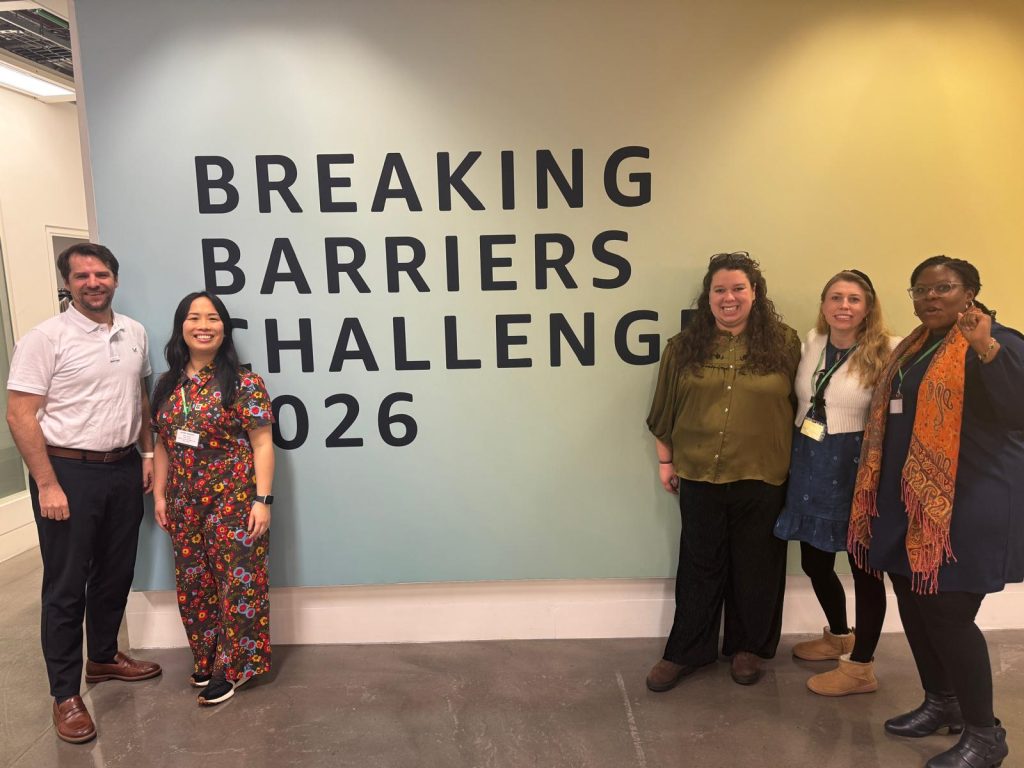
The three-day event held across three cities in the United Kingdom, bringing together over 500 people including 20 charities in 40 teams. The teams were made up of developers, software tech specialists and enthusiasts, and charities all focused on using AI to solve real humanitarian problems – in HLA’s instance – Kaya Match.
At the hackathon, HLA had three teams each working from a different viewpoint but towards the same end goal for building Kaya Match.
In this insightful article, we read first-hand reactions from James Maltby, Head of Global Engagement at the HLA, Lucy Hall, REMEAL Lead at HLA and Ka Man Parkinson, Comms and Marketing Lead at HLA – some members of the HLA build team who took part in the hackathon.
We also hear from as well as Romi, Siokhan and Ruben – experts who provided one of our groups with technical expertise during the hackathon.
Lucy: We recently won the Imagine grant for our Kaya Match idea, in your words, what is Kaya Match?
Kaya Match is new concept we are hoping to develop within the HLA. It is a matching platform that would match learners on Kaya to job listings or calls for volunteers and short-term surge support to crises in their local community. This will make the most of the knowledge and skills they have developed through their learning engagement on Kaya.
It allows the amazing Kaya community to be mobilised – if they choose – and turns their learning record data into tangible, real life impact for them, and for local organisations that want to engage local expertise.
James: Hundreds (including you) gathered for three days in London, Manchester and Dublin for the AWS hackathon; how was your experience?
For me the AWS Breaking Barriers challenge was about creating a space for us to think outside the box on an important challenge for the humanitarian sector and to collaborate with experts from across different industries.
I have attended many hackathons previously, but this was my first time as the product owner. That role acts as the voice of the primary user, which in our case was local organisations working in crisis affected countries.
Our team included specialists from the BBC who focussed on front-development and user experience, Crayon who built the backend server infrastructure, and finally Amazon experts who advised on the best use of AWS services.
Ka Man: What concept or brief did your team work on and how did you bring it to life?
My team was given the ‘wildcard’ choice of focusing either on the features for organisations to submit opportunities to Kaya Match, or the ‘under the bonnet’ aspect of the system matching process. We decided to focus on the upload functionality.
Even under competition time constraints, we invested significant time in discovery. My teammates – meeting for the first time that day – came from diverse backgrounds: developers from financial services, retail, and AWS, plus an MSc student from Imperial College. We discussed the briefs and the organisational context, particularly the time pressures, financial constraints, and high-stakes environment that local humanitarian leaders operate under.
Through these discussions, we realised that whilst the upload functionality seemed straightforward technically, the reality was far more complex. Humanitarians face low connectivity settings, varying standards for job descriptions, and work in multiple languages. In response, we designed a flexible system that allowed organisations to submit opportunities through multiple channels, including WhatsApp.
The team thrived by collaboratively shaping a technical solution that responded to the complex realities facing local humanitarian leaders.
Lucy: Through this hackathon, you experienced three fantastic and exciting approaches for bringing Kaya Match to life. What are you now looking forward to for Kaya Match?
So much!
What the Hackathon showed us at the HLA is that the technology element of this platform is the easy bit, now we need to work with learners and local organisations to really make sure that the technology is usable.
We have three really strong elements and approaches that were created, each with their own strengths and areas that can be improved.
The first team looked at the ways that jobs can be uploaded, and how organisations can engage with the platform.
The second team explored what makes a good match between learner profiles and jobs, and also created a personalised learning journey to improve the match quality which is something the HLA have been exploring for ages.
The final team explored a bit of everything – what impressed me was the use of WhatsApp and how that could be incorporated into the platform, instead of creating something totally new.
Ultimately, we want to bring all these ideas together in a way that works for local partners, learners. By building on the tests from the Hackathon, and co-creating the full journey with others, we will hopefully be able to build something viable that uses AI to tangibly shift the power of local expertise to local organisations and local crises in the coming months. Read Lucy’s reflection here
James: What is next for Kaya Match and what can our audiences look forward to in the coming months?
We are honoured that Kaya Match received an award as part of the AWS Imagine programme. The hackathon has enabled us to kick-start development, but what I am most excited about in the next couple of months is to start co-designing the solution with local organisations.
The true impact of Gen AI will come after enabling organisations closest to the problem to access the best practices and technology they need to build their own solutions. We also have a series of practical podcasts and webinars planned in response to our Humanitarian AI survey launched in 2025.
➡️ Watch James Maltby in conversation with Jose Gordon, AWS Global Impact
Ka Man: How has this hackathon experience influenced your view on Generative AI from the perspective of your research findings and work in humanitarian AI?
The hackathon reinforced several key insights from my research whilst also offering some new perspectives.
Firstly, seeing Generative AI used throughout the development process was eye-opening. The AWS team used conversational AI tools to guide developers and generate code, enabling them to build task-specific agents remarkably quickly. Coming from an era of line-by-line coding, the speed was striking – but what mattered more was observing how the team maintained quality control through experienced oversight. This validated a core principle from my research: Gen AI is a powerful accelerator, but human expertise remains essential for verification and contextual judgment.
Secondly, the focus on real-world implementation rather than flashy demos was reassuring. Even under time pressure, teams and judges across all three cities prioritised privacy, safety, and regulatory considerations. What particularly struck me was seeing security and compliance considerations explicitly flagged during development itself – I hadn’t realised these safeguards could be so integral to the process. They designed with end-users in mind – such as children, patients, carers, educators – keeping safeguarding central. This aligns with what my humanitarian AI research emphasises: technology must be shaped by the contexts and constraints where it will actually be deployed.
The experience strengthened my conviction that Generative AI has genuine potential in humanitarian settings, but only when combined with deep domain expertise, robust safeguards, and genuine understanding of user needs. Speed without these elements risks causing harm in high-stakes environments.
Finally, as a non-technical person, I came in unsure what my active contribution would be. I realised that contextual input and real-world experience are just as critical in this process as coding expertise. This reinforced my belief that all humanitarians – technical or not – have a stake in shaping AI development, and that diverse voices strengthen these solutions.
Speaking with some of our technical experts: Romi, Siokhan – a data scientist and Ruben – an MSc student at Imperial College, we gather an aligned perspective on how humanitarians should be thinking about AI and tech and vice versa.
What was your biggest takeaway from your experience building out Kaya Match at the AWS breaking barriers hackathon?
Siokhan: As someone working within the financial industry, I sometimes struggle to find meaning in my work, especially in the application of AI. It was good to see how much the technology can help the public sector, but the Hackathon definitely outlined the imbalance from a resourcing perspective.
Romi: My biggest takeaway was seeing how quickly a diverse team can move from problem to working solution when everyone brings different perspectives. We had people from tech, humanitarian work, university students, and various backgrounds—that diversity meant we caught blind spots early and built something grounded in reality, not assumptions.
The other revelation was the scale of impact: solving what seems like a “simple” matching problem could help mobilise volunteers faster across 900,000+ humanitarian workers on platforms like Kaya. When every hour of delay means aid that doesn’t reach people in crisis, even incremental improvements become lifelines.
Ruben: It has been a privilege to contribute to a solution that aims to bridge the skills built on the Kaya platform with areas where they can truly make a difference. One of the things I take away from this experience is the importance of having clear conversations upfront about end-user needs but certainly also their context, as fancy features alone aren’t everything. Especially in humanitarian solutions, there is so much nuance and underlying complexity.
Our team proved that constraints, such as poor internet connectivity or the lack of laptops, can trigger creativity when approached with the right mindset, ultimately resulting in an accessible WhatsApp version that compresses our web application into a simple message thread.
From your perspective and this experience, how should humanitarian organisations be thinking about tech and AI? And how should tech organisations be thinking about social impact causes?
Romi: In my opinion, social impact organisations should see AI and tech as tools to free up capacity for direct impact work, not as solutions in themselves.
The question isn’t “how do we use AI?” but “where are we spending time on manual, repetitive tasks when we could be helping people?” AI excels at handling the messy, unstructured work—standardising fragmented data, bridging language barriers, automating repetitive matching—so teams can focus their expertise where it matters most.
For those of us in tech working on social impact causes, it’s about embracing the complexity. These challenges have layers—low connectivity, multilingual contexts, fragmented systems—that make them incredibly rich problems to solve. The best approach is deep listening and building for actual conditions on the ground. Real impact comes from genuine partnership and staying curious about the nuances that make humanitarian work unique.
Ruben: I believe that technology, and specifically AI, can support social impact organisations where they currently face resource gaps, whether in terms of skills or manpower. As we saw with Kaya Match, even ‘simple’ applications can act as a powerful lever for daily mission-driven work. Of course, this often requires support during initial implementation.
The setup of this hackathon is ideal for this, as it offers charity organisations a low-threshold way to tap into tech talent that can provide solutions to some of today’s challenges in just a matter of days. At the same time for the companies and universities behind these initiatives, the cross-pollination of expertise is an invaluable return. It delivers new approaches to do more with less and may lead to long-term collaborations.
Ultimately, however, it should all come down to a shared and sustained commitment to positive change. Technology now plays such a central role in every aspect of our lives that it has become an inseparable part of that effort.
HLA expresses immense gratitude to Amazon Web Services hackathon organisers and all the teams we worked with during the three days – sparking new ideas and being part of our solution. We’re excited to go on this journey with you and the HLA global community.
We want to co-create Kaya Match with the HLA learning community. In coming months, we will share information on how you can be a part of this.