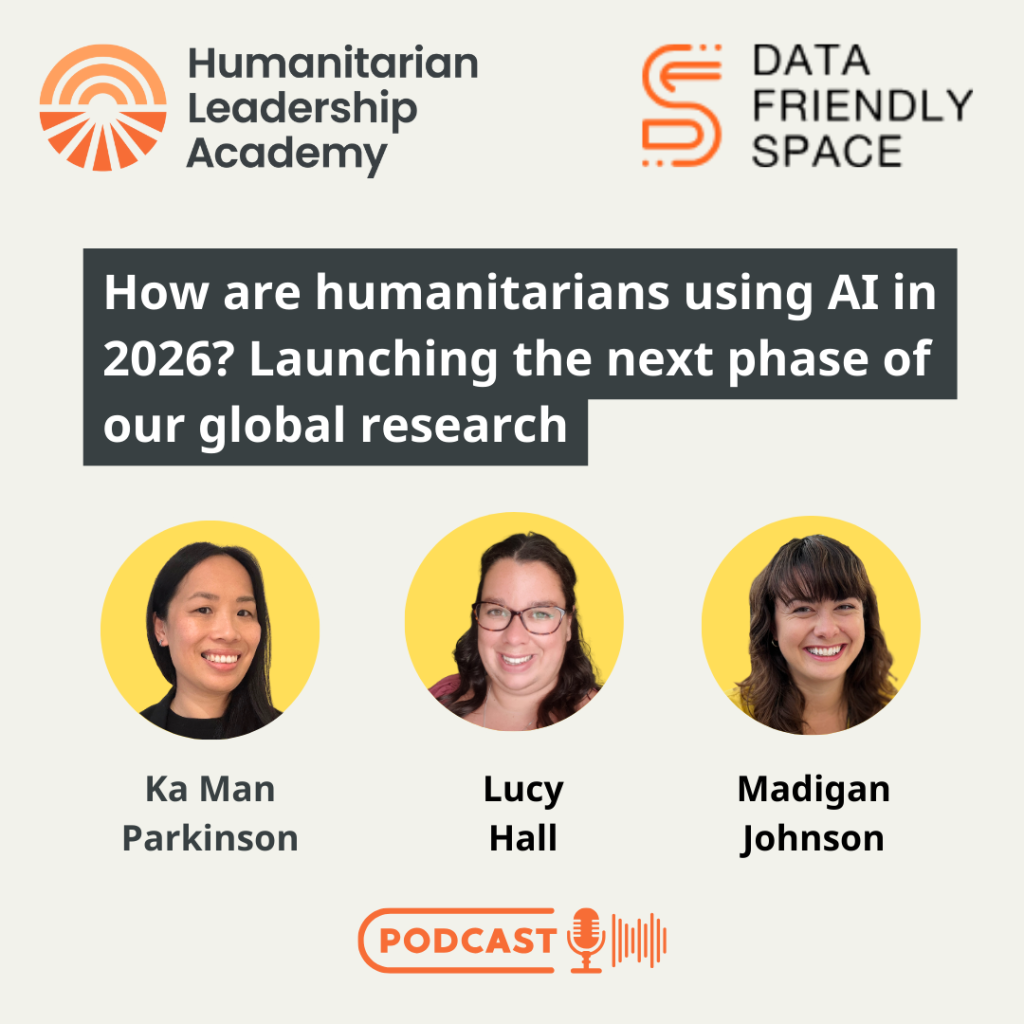
[Music]
[Ka Man voiceover]: Welcome to Fresh Humanitarian Perspectives, the podcast brought to you by the Humanitarian Leadership Academy.
Ka Man: Hi, Madigan and Lucy! Happy new year, and welcome back to the podcast!
[Music fades]
Lucy: Hello, happy new year! Nice to see you again.
Madigan: Hi, it’s so lovely to be here, happy new year!
Ka Man: Aw, thank you very much both. So first of all, thanks so much to you, personally, as research co-leads for our humanitarian AI research that we embarked upon last year. And of course, thank you to everyone who engaged in the study itself, taking part in the survey, as well as the interviews and all of the activity around that. We were truly grateful to be able to bring together our collective voices through this piece to support sector-wide dialogue and action in this space.
So, Madigan, Lucy, as we’re once again collaborating to take forward this next phase of our research into the use of AI across the humanitarian sector, I thought that this would be a really great point for us to catch up and take this opportunity to share a brief update on our current thinking and plans with our community.
So before we do that, I’d like to start by inviting you both to perhaps share a key takeaway or learning point that you had from our 2025 global baseline study. So let’s come to you first, Madigan.
Madigan: Yeah, thank you so much. So I think something that has really struck me from our research last year is what we termed the humanitarian AI paradox. And I know that we’ve said this quite a bit, but in our first global baseline study, it really showed that there’s this disconnect between humanitarians and organisations, so that 93% of humanitarians use AI tools, and with about 70% of them using AI daily or weekly, but only 8% actually work in organisations where AI is widely integrated.
So you have this individual adoption, but organisations are still really early in their experimentation phases. I think the other thing that also really stood out to me is, despite this high usage, attitudes about AI effectiveness are actually quite mixed. And we had, in our study, less than half of respondents agree that AI has actually improved operational efficiency. And so when people are using these tools, they’re not necessarily convinced they work, which creates real questions about the hype of AI in the humanitarian sector. And how and when we move from individual experimentation to this sort of responsible, strategic organisational adoption.
Ka Man: Thanks so much, Madigan. Yeah, absolutely, that was the headline finding, wasn’t it, that really resonated and gained traction as we released our insights last year, and that what you speak of really highlights that aspect of the humanitarian AI paradox really, really starkly. So, Lucy, how about you, what was your key takeaway?
Lucy: There were a few things that really stuck with me, actually. And I think one of them is the difference between international and local organisations. It really feels that there’s different kind of types of use cases, particularly around something that Madigan just touched on, it’s around that challenge around efficiency versus effectiveness, and how different groups, different types of organisations view AI tools.
And I think there’s also different levels of trust and safety to be talking about AI usage, and I think that’s something that really struck a chord when we were talking to so many different people.
And I think that links into my kind of final thing, that it’s around the risk appetite that exists within the humanitarian sector. Individuals kind of want to push risk as far as they can without compromising safety or protecting the communities that they work with. But as we kind of observed in that paradox, organisations just seem to be a bit stuck, and not really knowing or have the resources potentially, how to unstick themselves to really kind of move forward in the humanitarian AI era.
Ka Man: I agree, Lucy. That nuance and that complexity of the different types of humanitarians is something that really emerged and was really interesting, wasn’t it? Especially, as you mentioned, the contrast between international organisations and local organisations. And actually, someone actually asked me, what are we defining as local organisations, national, local – you know, it’s all quite fuzzy, isn’t it? So, that was a really interesting aspect that emerged.
And that local leadership piece was really, really interesting. Even, what do we consider to be a humanitarian? So, I’ve been talking a lot recently to people who are saying that people who don’t identify as humanitarians, they’re just working in their communities to support communities. You know like, Emergency Response Rooms in Sudan, we’re hearing about them using AI to write donor reports, for example, which really amazed me that, and they might not identify as a humanitarian, but there they are, doing this really crucial, life-saving work. So, yeah, thank you very much to both of you for sharing that.
So, yeah, these are themes and issues that we want to sort of delve into further in 2026, starting with this pulse survey that we’re launching. So it opens on Monday the 12th of Jan, and will be open through till the 31st of January. So we hope our listeners will be able to get involved and support us on our mission to capture fresh insights and data.
So, although we carried out our research just over half a year ago, it feels like there’s been, since then, wave upon wave of difficult change across the sector. I think we’re all too familiar with these challenges around funding, structural change, technological change, and much more. So, we hope that through this next phase of research we’ll be able to understand and learn a little more about how and if these challenges are impacting on use of AI in the humanitarian sector. And this pulse survey is supposed to be just a really light-touch way to gather updated global data that we can turn around quickly and share with the sector as we collectively grapple with these changes, make plans, and navigate what’s ahead in 2026.
So, I’ll just pause there if you want to come in and share some thoughts or reflections, Madigan?
Madigan: Yeah, I think from my end, what I’m really curious to see is if this humanitarian AI paradox we identified has either intensified or started to kind of resolve itself. I mean, given the funding crisis that we find the humanitarian sector in, and especially with the organisational restructuring, I really want to kind of understand from this new data that’s coming in if this is either accelerated AI transformation, because organisations are really desperate for these sort of efficiency gains and to be able to do more with less, even though I hate that phrase.
Or whether it’s actually hindered progress, as there’s been all of these radical changes, and you know, AI is this new technology that also demands this sort of change in way of working. Like Lucy, and you mentioned as well, I think I’m also very curious to see if we’ll see changes in how local versus international organisations are adopting AI.
Our 2025 data showed some really interesting patterns where local organisations seemed much more willing to experiment and share their work openly, and I think, Lucy, what you said about, like, the sort of the risk, you know, management or aversion, you know, that’s something that I think we need to really kind of talk about. Especially when we were looking at the data from before, where international organisations were much more cautious. So I’m really quite keen to see if those dynamics have shifted at all in the last 6 months, and if we’ll see some new trends appear there.
Ka Man: Absolutely. How about you, Lucy?
Lucy: Very similar. I think for me, I’m just looking to see what, if anything, has happened. Has anything changed, and what does that look like? I think it would be really interesting to see the differences between international and local organisations. I’ve kind of got a bit of a hypothesis as to what might have happened. I don’t want to skew the results or influence any of our listeners, so I won’t share my hypotheses with you all. But it did feel that there was some trends and patterns starting to emerge at the end of 2025.
And they were starting to build a real consensus around use cases, the risks, and the benefits of AI, and what our collective boundaries might be, so I’m interested to see if that holds true. Especially against the backdrop of the funding constraints and the political climate, I think it’ll be interesting to see if this has accelerated AI transformation or hindered AI governance and protection, or maybe not.
In the grand scheme of things, whether that’s from a technological perspective or from a humanitarian perspective, six months isn’t actually an awful lot of time to grapple with some of the challenges that we’ve surfaced and we’ve discussed and figure out a way forward to really influence change, so we might not actually see any shifts, and I think that will be quite exciting and interesting in and of itself.
Ka Man: Yeah, I agree. It could go any way, couldn’t it, really [laughs] given the complexity of the sector and technological shifts, and political shifts, like you’ve mentioned, Lucy.
So because we’re all interested in this difference between individuals, local organisations, the international sector, like INGOs, UN, etc, that to us is interesting structurally, how the picture looks. I thought it was really interesting, I read an article recently in the UK Humanitarian Innovation Hub newsletter, I think it was the December issue, and Brent Phillips, who’s the host of the Humanitarian AI Today podcast, was talking about pilots in larger humanitarian organisations stalling due to the lack of funding, how things were budgeted for in the last cycle, and now we’re coming to the end of that cycle, and now funds are drying up, and he’s calling it a ‘humanitarian AI winter’, which I assume refers to quite a fallow period. So it’ll be interesting to see if this data reinforces that picture, whether that reinforces that picture, or whether something different emerges from the people who respond to our survey. So, yeah.
So, on to the survey itself. Hopefully, if you’re listening to this, you’re already interested and want to take part, but, yeah, just to let you know, it’s a 5-minute survey, open to anyone in the humanitarian space. So whether you’re working in the sector formally, a volunteer, a student, or in an adjacent field but have a particular interest in humanitarian work, we invite you to take part. You don’t have to be using AI or even positive about AI. In fact, even if you’re actively against the use of this technology in humanitarian work, we invite you to take part, as we really do want a wide spectrum of views and experiences to be represented in our data.
So, like I say, as long as you have an interest, please do take the survey and let us know about yourself and your experiences. It’s simple multiple-choice questions, and if you took part in the 2025 survey, you’ll recognise some of the same questions as we’re repeating those so that we have a direct comparison to the key metrics that we reported on, and we’ll be able to track any potential shifts in that data.
And we’ve also added in a new multiple-choice question around use cases, what specific tasks you are using AI for. So, we’re not just asking which tools you’re using, but specific multiple-choice question around how you’re using it. So I’m genuinely excited to see what emerges. For example, around 70% last time said that they’re using commercial agents like ChatGPT and Claude daily or weekly. I’m really interested to see if that’s shifted. I was almost tempted to suggest that we add more than daily, but I thought, let’s just keep things the same for now [laughs]. Maybe further down the line in the next wave, we’ll add in hourly [laughs], more increments. So how about you, Lucy, what are you personally excited to see potentially emerge in the data?
Lucy: I love the idea of adding more increments. Maybe we, you know, talk about whether we want a brain chip of AI in at some point [laughs] for a humanitarian action. I think that’s the route that it feels as if we’re trying to head down, but I don’t think is.
On a more serious note, I think what I’m really looking forward to seeing is exactly what we’ve just talked about, the use cases, how people are using AI, whether it’s any different, whether it’s the same as it was 6 months ago. As I alluded to, I’ve kind of got a hypothesis of how these use cases could potentially have split.
The main thing that I’m really excited about is what actually comes next after the survey. For me, the study we did last year really accelerated a lot of these conversations, and it really grounded the debate about humanitarian AI in evidence. So I’d love to see that just continuing this year. Especially looking at how this influences and informs locally led humanitarian action, as well as locally led AI.
And I’m looking forward, I’m excited to see how we can use these findings to really advocate for more innovative ways of accelerating locally led humanitarian action, practically as well as conceptually and strategically, and base it on real, relevant, current experiences of the global community here.
Ka Man: That’s brilliant. I couldn’t agree more there, especially the piece around local leadership. So how about you, Madigan, what are you excited to potentially see?
Madigan: I mean, just to reiterate beyond, like, the use cases and the local leadership, I think what I’m really excited about is also the dashboard that we’ll be updating with this sort of survey data, as has put this data in the hands of the people and of the community here, and allows them to kind of see how others are using it, and to possibly even kind of recognise themselves in that data. I think something that kind of stood out in a lot of the conversations that we were having last year is that people were playing around with the dashboard or user personas, and were like, oh, that sounds like me. And so I think that’s what I’m really kind of looking forward to is to, you know, have people recognise themselves and be like, I’m not alone in this AI journey, or in this era.
I think the other thing is that this isn’t just a one-time snapshot, and so we’re now kind of consistently measuring this progress, and we’re identifying these trends, and we’re really giving the sector this evidence around AI usage. And so I’m really hoping to see whether these conversations and initiatives that have emerged since our last study are actually translating into, like, measurable changes on the ground, or if it’s still talk. And like Lucy mentioned, I think, you know, I kind of also have a bit of a hypothesis that I think will be kind of, we’ll see how it goes.
But really, are organisations moving from this sort of awareness to actual action, knowing that a lot of people within their organisations are already using AI in their work, even if it’s just shadow AI usage? So I think that’s gonna be really telling of the humanitarian sector for kind of making progress, or if we were making strides and, you know, going from the talking and the research, which is so important and so valuable, but then into the practicalities of, well, I think, you know for me, one of the things that kind of stood out is, you know, with Ali Al Mokdad when he provided the training in Sudan, and again, that, you know, sort of originated from parts of our research. But then it actually has this sort of, like, direct impact, and so really curious to see if that’s gonna emerge more in this new survey study.
Ka Man: Yeah, 100%. I’m really excited by and just really encouraged by the sort of outputs that have emerged, that our research has been the springboard to certain initiatives happening – the training that you’ve mentioned for local responders in Sudan, that our Save the Children Sudan colleague set up.
And also, the dashboard is brilliant because we’ve had a number of researchers connect with us and build on some of the insights and contextualise it for their setting, so we – the use of AI-generated imagery in Türkiye, which is actually, now there’s cross-fertilisation of ideas because now that researcher is looking to speak to Save the Children in Sudan about potentially linking up and connecting the dots there, so that really excites me. We have researchers in lots of different contexts, we’ve had requests for access to the data – signposted people to the dashboard – from universities in the UK as well. So, we want to see more of this. Oh and then the other one that was also very interesting [was Alliance Ukraine, which is an alliance of 26 civil society organisations who have used our research, written a contextualised briefing note, which they’re using for their advocacy, for humanitarian AI in a conflict context. So I mean that to us is just incredible that a survey can have this real-world impact that’s grounded in evidence. So, if we can be of service to the sector with your help, with everyone’s help, by filling in the survey, just think, you know, what can happen, this real-world impact. So that really motivates us and galvanises us in our mission, particularly to support locally led humanitarian action.
So, yes, thank you so much to both of you and to our community. We hope that you’ll spend 5 minutes, as well as listening to this conversation, to fill in the survey, share with your networks, hopefully we can get as wide a cross-section of people as possible to take part. As I’ve mentioned, the survey is open through till 31st of January. And then we’ll try our best to turn that around as quickly as possible to share insights with you all from February, so we’ll be, keep an eye on our social media channels, particularly LinkedIn. We’ll post announcements on there.
And then we’re hoping to also put on a webinar further down the line and share, and have a bit more of discussion around that. So, stay tuned.
So before we sign off, Madigan, do you have a final message to share with our listeners?
Madigan: Yeah, first of all, I want to say thank you to all of our listeners and to everyone that will be participating in the survey, or has. I want to say, just be very real about your experience with AI, you know, whether it’s working for you brilliantly or failing completely, you know, this is the sort of information that is really valuable, and sharing these sort of real challenges, you know, again, there’s all of these linkages that I think you Ka Man, you just mentioned, and so it’s really helpful to kind of learn about the challenges, but also the successes and innovations that also come out of this.
I think, you know, from our previous research, some of the most impressive AI implementations we documented came from practitioners that were working with very limited resources, you know, but we were solving really real problems in very creative ways. And so, the 5 minutes that you fill out this survey could really help shape how the sector navigates this technology. And if we don’t ground this conversation in real practitioner experiences, we risk creating solutions that don’t actually work for the people doing the work. So please share your voice, and very much thank you to everyone that has.
Ka Man: Thanks very much, Madigan. And how about you, Lucy? What’s your final words of wisdom or message to our listeners?
Lucy: Exactly what Madigan has just said, this is a space, one of the, what feels to me like one of the few spaces where real stories, real evidence is really shaping an emerging sector and an emerging space within humanitarianism. And it’s your voice that matters. We’re the vessel, basically, to channel your voice through. That’s what the survey is. This is all about your experience, what you want to see what you think the challenges are with AI, what you kind of hope to see happens as a result of using, engaging with AI, even if you don’t really know what AI is, which is completely fine, and completely valid, because we talk about this as if it’s taking over the world.
But not everyone feels comfortable to do so, and I think that is important to share and talk about as well. So, just please be honest with your experience, with your thoughts and your realities. AI is quite a weird, complicated, and quite an emotive topic to talk about, and is quite often overhyped. We do believe that the potential is real with huge challenges, but we don’t know that without you sharing your experiences, stories, and realities. So, very much looking forward to seeing what can come next.
Ka Man: Thank you, Lucy. I think that’s really key, about that trust and you know, we’re going to be – we take our responsibility seriously, ensuring that confidentiality in this safe space for you to share your experiences, and we don’t have an agenda. We don’t want you to respond in any particular way, we just want to reflect your real-world experiences.
So, thank you very much to you both for joining me for this conversation today, and to outline our thinking behind this pulse survey. So, thank you very much.
And just before we close this conversation, I just to highlight that both Data Friendly Space and the Humanitarian Leadership Academy will be presenting sessions at the upcoming HNPW, which is Humanitarian Networks Partnerships Week, I believe. It’s a bit of a mouthful! I don’t think the agenda is published online just yet at the time of recording this conversation, but it will be live soon, so if you Google HNPW 2026, you should be able to find details.
But just related to this particular piece of work that we’re working on, the HLA is leading an online session that’s open to everyone to join. It’s a Zoom webinar format on the 3rd of March. And that session is called ‘Bridging Digital Divides: Centring Local Leadership in Humanitarian AI Development’. And Lucy and I will be leading that session together with some local leaders. So, one of those will be the aforementioned Turkish researcher who’s researching into AI-generated imagery in the Syrian context, and we’ll hear about her research, and we’re hoping that a colleague from Sudan will be able to join us for that too, but we will confirm that with everyone, and so keep an eye out on HLA channels for that. Madigan, did you want to mention anything around DFS sessions before we sign off?
Madigan: Yeah, so we actually have two sessions. One will be online as well, and that one will be focused on GANNET, our AI tool, and one of the deep dive features that we’ve included there, so basically how we’ve now been pulling in quantitative data from the Humanitarian Data Exchange. And then the next one we’ll be doing in joint with Kobo Toolbox, and this is talking about the human in the loop. So basically the human in the loop process of creating AI tools, and what that actually means and practice and reality. I’ll have to confirm the times and dates, but again, keep an eye out for the DFS social media channels, because we will be posting there.
Ka Man: Brilliant, thank you. Those sessions sound great, and that information is hot off the press, so that’s why we don’t have all of the confirmed details just yet, but we’ll include those details in the show notes as soon as they’re available.
[Music]
So, thank you very much, Madigan and Lucy, and thank you to our listeners for joining us for today’s conversation of Fresh Humanitarian Perspectives from the Humanitarian Leadership Academy.
[Music fades]