16th November 2026

How is AI reshaping humanitarian communication – and what’s needed to support practitioners?
In 2025, the Humanitarian Leadership Academy (HLA) and Data Friendly Space (DFS) led the world’s first global study into how humanitarians are using AI, forming a global baseline that is informing and shaping policy, governance, research and sector-wide discourse.
In this interview, we reconnect with Gülsüm Özkaya, International Humanitarian Affairs Coordinator at IHH Humanitarian Relief Foundation in Istanbul, where she is also a member of the Centre for Humanitarian Impact team. She recently completed her MA in Strategic Communication Management where her thesis focused on AI-based visualisation and representation in humanitarian communication, through a discourse analysis in the context of the Sudan crisis.
The HLA’s Ka Man Parkinson, humanitarian AI research co-lead, caught up with Gülsüm to hear her key research insights – from balancing donor expectations and fundraising pressures with the dignity of the communities we serve, to the growing influence of social media algorithms.
Gülsüm’s research points to a clear gap: humanitarian communicators sit at the centre of these competing pressures, yet have little guidance on how to navigate them – especially when it comes to AI. She calls for common standards and frameworks to help close the gap.
Research initiated by practice and an ethical dilemma
Gülsüm’s path into AI research began with a dilemma at work for a nonprofit charitable organisation: a request from donors that ran up against her organisation’s child protection policies.
“It started with a story from last year. A group of donors to our organisation requested to sponsor an orphanage, and they requested pictures of the children. But as an organisation, we have some protection policies, and we don’t want to share as it would have revealed identifying details.
But they also would like to see something, so we thought that maybe an AI-generated image would fulfil their needs of gaining some visual context. I felt this was an opportunity to meet the donors’ needs while protecting the children’s dignity and privacy, which is the most important thing in humanitarian communication.
So I started with these AI images, but I realised that their engagement with the AI images was actually worse than having no images at all.
With their insistence, when we shared the AI-generated ones, on the donors’ side, it was felt that the use of AI images seemed to decrease the serious nature of the situation. They wanted the images to reflect that reality. In the end, this donor group did not become sponsors.
So then I started thinking: what are the implications of using AI-generated images in crisis zones? Because we’re also working in crisis zones, and in some crisis zones we also need to provide some pictures, visuals – but how does it affect people’s perceptions?”
AI-generated imagery in humanitarian communications: a lack of consensus
This question became the basis of her master’s thesis – one of several academic studies happening in Colombia, Switzerland and Germany that have been informed by the HLA/DFS humanitarian AI research. What she found from her interviews with communicators and crisis-affected communities was not clear cut – but it pointed to a clear lack of much-needed frameworks and guidance.
“I found from my interviews that there was no clear pattern of people being for or against AI. Their views weren’t that rigid. Almost all of my interviewees talked about both the benefits and the risks of AI, and no one made a clear decision never to use it.
What made the difference was the perspectives and intentions of humanitarian communicators. Most interviewees asked: ‘What is the intention behind humanitarian communicators using AI to represent us, or to represent crisis-affected people?’
If it’s for fundraising, I found that communicators I spoke to don’t always support its use. But if it’s for advocacy – to make the crisis more visible and clearer to people – they were generally in support of it.
If it protects dignity or privacy, using AI can be acceptable. But not if communicators simply don’t want to go to the crisis area, and would rather stay at headquarters and create content from there.
In my thesis, I call it a double-edged sword. On one side, AI clearly protects privacy and dignity. On the other, it can undermine how seriously people take the crisis. Where should the balance be?”
For Gülsüm, part of the answer lies in who tells the story.
“As humanitarian communicators, we need to find ways of telling the stories of crisis-affected people when their media infrastructure has collapsed. That’s exactly why I chose Sudan. And we need to tell these stories together with them – diaspora communities have a very important role here.
AI is obviously in our lives right now. It’s not reasonable to avoid using it. But how can we use it more effectively and in a more ethical way?”
Aligning perspectives: a ‘triangle’ of stakeholders
Gülsüm’s thinking was also shaped by the HLA/DFS 2025 survey on humanitarian AI adoption. It prompted her to look at the problem from a new angle – that of humanitarian communicators themselves.
“I had already been following HLA’s work for some time, so when a colleague shared the survey with me, the questions immediately caught my attention because they were very similar to the ones I had been exploring in my own work.
At the time, I was curious but unsure where to start. I was wondering whether AI even had a place in this work, and I didn’t even know whether people were discussing it. When the report was released, I realised there was already some data – people had already started working on this, so I could build on it. Seeing that you were holding discussions with different organisations was hugely encouraging. It became my starting point.
It also prompted me to start thinking more deeply about the use of AI from the perspective of humanitarian communicators. I wanted to understand why, as humanitarian communicators, are we providing AI-generated images? What would motivate us to do this?
So there are three sides, as I see it: the donors, beneficiaries, and humanitarian communicators. In that triangle, I started to think: how can I address all of their needs at the same time? That was the beginning.”
An earlier study of communicators in Türkiye – who told her their strategies were built around donors – led her to centre crisis-affected people in her thesis, with communicators’ perspectives alongside.
An invisible actor: social media algorithms
Gülsüm‘s interviews pointed to a fourth force shaping every decision – a theme also explored in our April 2026 podcast conversation on humanitarian communications.
“I may have described it as a triangle, but there’s something else we need to consider. One humanitarian communicator told me: we don’t only consider what donors expect – we also consider what the algorithms expect.
Instagram, TikTok and other platforms – their algorithms matter a lot when we’re developing our strategy. For example, if there is an image of a child with an injury – we’re not just asking whether it respects the honour of crisis-affected people, we’re also asking whether the algorithm will show it to people at all.
The platforms themselves are shaped by AI and the companies behind them – so when you post about a crisis context, how far it reaches depends on their decisions.
So the question is: who is the gatekeeper? It’s not always the humanitarian communicators. We’re mainly just trying to get our content through the gate so that more people see it. But who decides what becomes visible? The algorithms.”
AI policy vacuum: following ‘conscience’ in the absence of guidance
With few formal policies to lean on, as highlighted in the HLA/DFS study, how do humanitarian communicators make difficult calls? The answer Gülsüm heard most often came down to a single word: conscience.
“Humanitarian communicators aren’t simply on the donors’ side, or directly on the side of crisis-affected people. They are trying to find their own way – and most of them describe it as ‘following my own conscience’.
I asked all the humanitarian communicators I interviewed: what is the main basis of your organisation’s communication strategy? Most of the time, they said: we don’t have a specific humanitarian communication policy, but in difficult situations, when we’re not sure what to do, we rely on our conscience.
For me, our responsibility is to protect dignity and privacy above donations – even though those donations directly improve people’s situations.”
But one Sudanese interviewee challenged Gülsüm’s own thinking about what dignity means.
“My colleagues and I discussed this before. There were very distressing pictures coming out of Gaza. We know that sharing them would increase donations. But we don’t want people to think of Gazans in that way, because they are resilient – they are stronger than this.
That was how I used to think. But when I told one of my Sudanese interviewees that I didn’t want to share pictures like this, because I didn’t want people to remember Sudanese people that way, she said no: ‘We shouldn’t hide it, because the consequences of war should be seen… We are not strong. This is the war, these are the things we have been through. People need to see this.’
It was so eye-opening for me. That insight is worth more to me than the thesis itself.”
A call for common standards for communicators
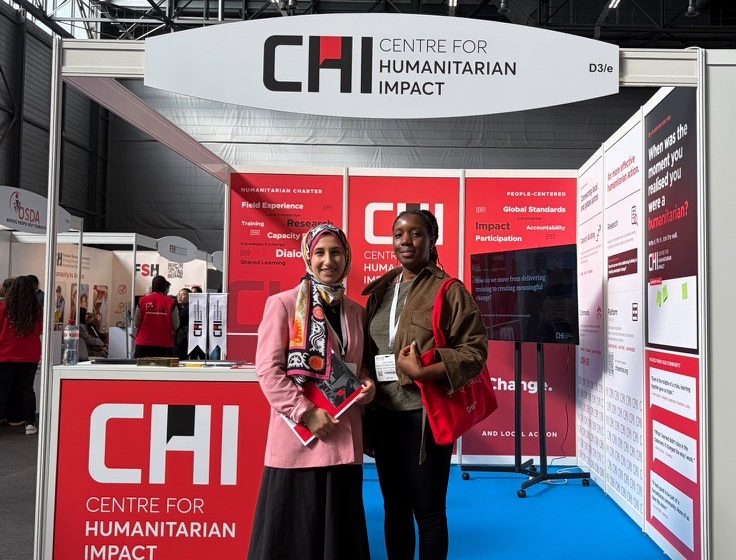
Gülsüm calls for humanitarian communicators to shape sector standards together.
Pictured: Gülsüm with the HLA’s Julia Amoo at AidEx 2026 in Geneva. Image supplied.
Across her interviews, one gap came up time and again: humanitarian communicators are making these calls without standards to guide them.
“One of the communicators told me directly: we’re eager to learn about international standards, but we can’t find anything specifically for humanitarian communicators. Whether or not they end up applying them, they need standards when facing difficult decisions.
One interviewee told me about a major crisis in Darfur. They couldn’t get access, but they wanted to tell people about Darfur. If they used photos, people might assume they were in Darfur when they weren’t – and they didn’t want to mislead anyone. So they used AI-generated images of people, but they also didn’t want people to think the images were real, so they used an illustrated style. You can see what a difficult position they’re in.
There is clearly a huge demand for humanitarian communication standards right now. I think Sphere is recognised by many organisations – and the CHS (Core Humanitarian Standard) too – so maybe we can build on these.”
For AI, Gülsüm believes the need is urgent.
“AI is moving so fast – it’s hard to keep up. If we miss this moment, I think it will be much harder to catch up later.
The generational gap in organisations is getting too wide. I’m 26, and one of my interviewees was 19. He was producing all of his organisation’s content, and he knows more about AI than I do – even though I call myself AI fluent. His manager is probably around 40 or 45. He told me: they just let me do everything, and I only show them the results, because they can’t follow how I use these tools.
That’s understandable – but who is overseeing his work? Who sets the limits – the policies, the strategies? Someone has to. We need to work on it immediately.”
Gülsüm wants communicators to shape those standards together – an idea she has championed since she first suggested a humanitarian communications community of practice.
“I wish we could all come together in the same room and discuss things with each other. One is considering algorithms more, another on standards, and another considering the effort required from staff, another on the cost. If we can come together more, we can create our own strategies on it.”
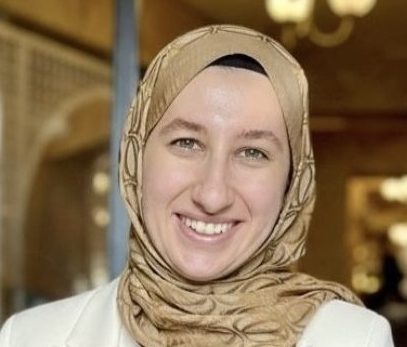
As humanitarian communicators, we need to find ways of telling the stories of crisis-affected people when their media infrastructure has collapsed… and we need to tell these stories together with them.
Congratulations to Gülsüm on the completion of her research, and we wish her all the best as she takes these insights into her work and the wider humanitarian communications community. This interview was conducted to build on and highlight the impact of the Humanitarian Leadership Academy and Data Friendly Space Humanitarian AI 2025–26 research initiative. Supporting resources – including reports, podcasts, webinars and microlearning guides – are available on the research landing page.
You may also be interested in
A research perspective from Colombia | Humanitarian AI research in action: a humanitarian technologist’s view from Colombia
Opinion | Should we use AI-generated imagery in humanitarian communications? Spotlight on research by Gülsüm Özkaya – our first conversation with Gülsüm, November 2025.
Podcast | Attention, algorithms and AI: How humanitarian organisations are rethinking communications in 2026 – Gülsüm and Amanda Hinkel-Mauceri of Humentum in conversation with Ka Man Parkinson, April 2026.
Webinar | Bridging digital divides: centring local leadership in humanitarian AI development – HNPW online session featuring Gülsüm, March 2026.
Disclaimer
The views and opinions expressed in this interview are those of the featured individual and do not necessarily reflect those of their affiliated organisations. This resource has been produced as a contribution to ongoing discussions on the use of AI in the humanitarian sector. Publication does not constitute endorsement of any specific technology, individual, organisation or approach.