29th September 2026
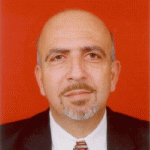
A lifetime spent watching the land change
Dr Jad Isaac has spent nearly four decades thinking about what’s happening to the Palestinian environment, long before “climate change” was the term anyone used for it. He traces it back to organising the first environmental conference in Palestine in 1985, and later representing Palestinians in the environmental working group of the multilateral peace talks in the early 1990s. It’s clearly not an abstract interest for him. “If we do not tackle global climate change,” he says, “humanity and the Earth itself are at risk.”
Deep connection to the land
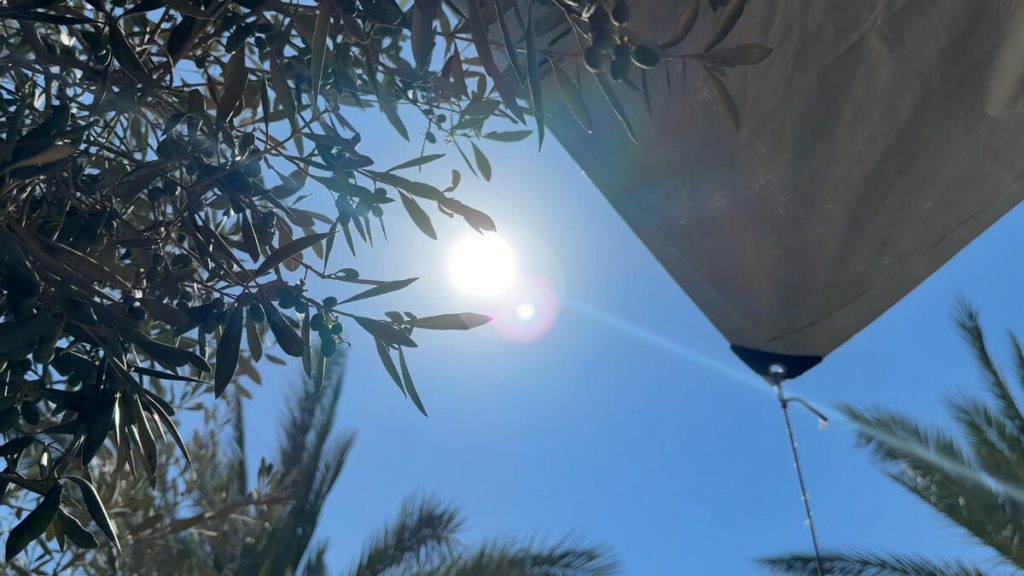
Jad describes bulldozers cutting new roads through the West Bank not as infrastructure but as wounds, warning that the heat they generate will dry the land further. He talks about olive trees with something closer to devotion than analysis: “There is an almost unearthly love between the Palestinian people and olive trees.”
Even his account of Gaza’s destruction slides quickly from human loss to ecological loss, as though he can’t fully separate the two – homes, wells, roads, and agricultural land.
“Think globally, act locally”
Where the conversation turns practical, Jad’s tone shifts to one of determination and calls to action. His philosophy, as he puts it, is “think globally, act locally,” paired with a belief in what he calls “small is beautiful” – the idea that Palestinians don’t need to wait for sovereignty, funding, or political resolution to start adapting.
He talks about restoring ancient wells for herders, helping farmers build biodigesters, encouraging people to grow food on rooftops and balconies – actions matter, no matter how big or small.
Carrying the cost and paying the price
Jad keeps returning to the people who bear this hardest – and it’s clear it matters to him personally. He talks about women spending hours each day just to secure water for their households, and insists they should be central to any response, not an afterthought. He sees women playing a pivotal role as “they are the ones most affected by climate change.” He calls for urgency and action: on basic standards, donors prioritisation of resilience, and a real recognition those least responsible for the climate crisis are paying the highest price.
Hope
Despite the immense challenges, Jad is hopeful: hope for what could be built in Gaza’s reconstruction, if people choose to build it differently. He imagines Gaza’s coastline lined with wind turbines, powered by what he says are strong offshore winds. He imagines every home with two water systems – one pure enough to drink, one for everything else -something, he says, that would make Palestine “the first region to use a dual water system.”
It’s less a policy proposal than a wish, spoken by someone who has spent most of his life watching this land get harder to live on. “The new Gaza,” he says, “must be built as a green, clean Gaza.”
This article is based on a conversation between Jad Isaac and the HLA’s Huseyin Arslan on the Arabic-language podcast interview: Climate change in Palestine: its dimensions, implications and mechanisms for adaptation. This episode forms part of the Local leadership in humanitarian action: voices from Palestine podcast series produced by the HLA in partnership with Save the Children. Audio in Arabic. English and Arabic transcripts available.