This transcript has been generated using automated tools. It has been checked but minor errors or omissions may remain.
[Intro music]
[00:00] Chapter 1: Introduction
[Voiceover, Ka Man]: Welcome to Fresh Humanitarian Perspectives, the podcast brought to you by the Humanitarian Leadership Academy.
[Music changes]
[Voiceover, Gülsüm]: In our sector, there’s not much you know, funding, especially after the cuts. So we need to find very creative and like the smart solutions to our problems.
[Voiceover, Ka Man]: Actually, this is the time to retain that real human decision-making — the human-in-the-loop, as we say — and make sure that’s at the heart of it.
[Voiceover, Amanda]: I think we as comms professionals, we need to be honest with ourselves too, and say we need to get better at telling our story and making people care about the ‘so what’ and the ‘why’, so that it helps people realise what we’re doing is mission critical.
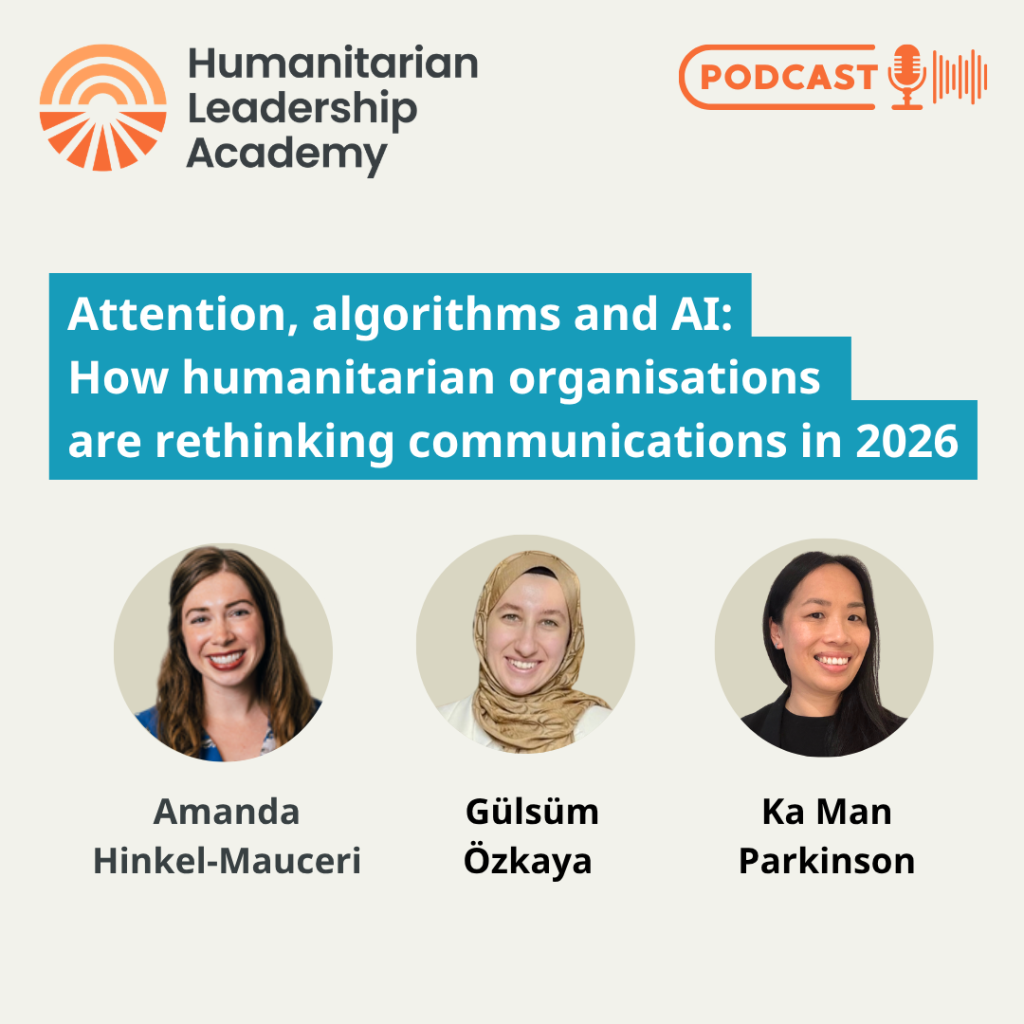
[Voiceover, Ka Man] How are humanitarian organisations rethinking communications in 2026?
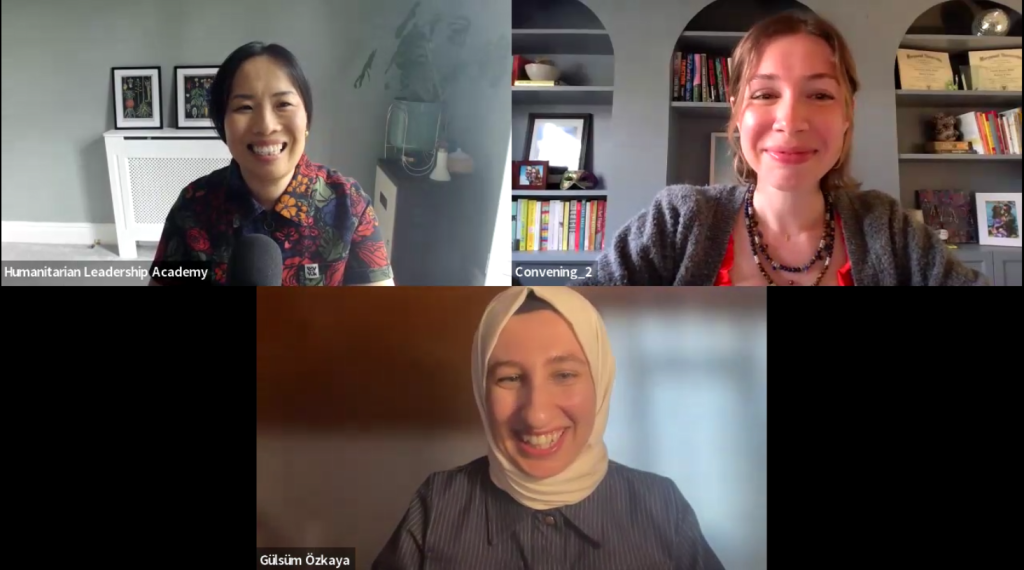
I’m Ka Man Parkinson, Communications Lead here at the HLA and in today’s episode we’re exploring this very question through a candid, three-way conversation with peers. I’m joined by Amanda Hinkel-Mauceri from Humentum and Gülsüm Özkaya from IHH Humanitarian Relief Foundation.
This is an informal yet thoughtful and thought-provoking conversation, where we discuss the shifting communications landscape in 2026, what’s working for us from our vantage points and what’s not — from the rapid rise of AI and tools reshaping comms, to the growing pressure to communicate more impactfully and cut through the noise, while still protecting core principles and values such as ethics, dignity, and trust.
We hope this conversation will resonate with both communicators in the humanitarian field and the nonprofit space tackling common challenges as well as those in other roles who are curious what your comms colleagues may be working on or thinking about – hopefully sparking ideas for your next collaboration.
[Music ends]
Ka Man: So, Gülsüm and Amanda, welcome to the podcast!
Amanda: Thanks for having us!
Ka Man: I’m so excited to have this conversation with you today, especially because it’s about comms, which is obviously something that we’re all passionate about. So, to get started, would you like to briefly introduce yourself to our listeners? Let’s start with you, Gülsüm.
Gülsüm: I’m Gülsüm Özkaya. I’m working for an NGO based in Istanbul, Türkiye — IHH Humanitarian Relief Foundation. I’m working as an International Humanitarian Affairs Coordinator. And also, I’m pursuing my master’s degree on humanitarian communication. I am writing my thesis right now. It’s about how to use AI in humanitarian communication, and the perception of crisis-affected people while being represented in humanitarian communication products.
Ka Man: Thank you, Gülsüm. It’s so exciting for you to be here — especially as our organisations and our paths have crossed in different ways over the past year or so, so it’s nice to have this time to sit down and chat to you. So, Amanda, let’s come to you, would you like to introduce yourself?
Amanda: Yes, thank you. My name is Amanda, I’m the Director of Marketing and Communications for Humentum, and we’re a global nonprofit that helps other NGOs and nonprofits enhance their long-term resilience and navigate change through training, consulting, and membership as well. And I’ve been with Humentum for 8 years now overseeing marketing, comms, PR, video, graphic design — you name it — so a bit of everything, myself and my team manage. And I will say, in hearing a bit of both of your backgrounds, I didn’t necessarily expect to end up in comms, and I didn’t necessarily expect to end up in humanitarian global development either. And I actually came from an arts management background, and while I’ve been now in this sector for 10-plus years, it’s still a bit of a learning curve sometimes. So I’m so thrilled to just have a conversation with you both, and really just share what we’re hearing, what we’re seeing, and what’s working — and really also, what I think everyone’s interested in is what’s not working, and why, and what new ideas we can bring to the second half of 2026.
Ka Man: Thank you, Amanda. It’s so great to have this conversation with you today. So Humentum and the HLA have been partners — we’ve collaborated on courses on Kaya and other initiatives over the years, but our paths have only crossed the past year, I think, after we connected on LinkedIn. So it’s so nice to talk to a fellow comms professional. And we’ve had chats and Gülsüm and I have had chats, and there’s common ground. We’ve just discovered that we all like history, that was our favourite subject at school! [Laughs] We love learning about the past and how we can apply that to the present, as well as fond of literature as well. And Amanda, you were talking about, you weren’t expecting to be in comms, but here you are — you and I have had conversations about applying creativity into work and bringing in that perspective. So, although it might feel disparate in some senses, in other ways, it’s really holistic part of our lens and way of viewing the world, right?
Amanda: Yeah, absolutely. It’s been so fascinating because you know, arts and culture and comms are not far off at all, and the more you can bring in all those cross-disciplines, your messaging is stronger, your stories are stronger. It’s a really nice collaboration that makes a lot of sense when you think about it sometimes a bit more.
Ka Man: Absolutely, I love that. I’m really here for the whole interdisciplinary approach — that’s what I think comms actually has to evolve and become more like in the coming period, which we’ll talk about a bit more shortly.
So, the format of today’s podcast is going to be a little bit different. So because the three of us are comms professionals, it’s going to be a bit more of a dynamic conversation, so in turn, we’ll ask each other questions, so it’s not just me posing the questions.
[06:39] Chapter 2: What’s changing for communicators in the shifting landscape?
So much has changed for everyone in the system over the last — well, it’s been more than a year, but it’s been particularly acute since 2025 onwards. So can I turn to you first, Amanda, to ask: what’s changed for you within Humentum, and for you as the Director of Comms, what’s shifted?
Amanda: It’s been quite a rollercoaster, if you will, since 2025, when we had the USAID funding cuts. And Humentum, like many organisations, we reduced our structure and staffing footprint due to those cuts, so it really caused us to think about a lot of things differently. How can we be doing more with less? How can we be doing different things with less? What are the right things that we should be focusing on that best delivers on our mission and vision? And it was a really interesting timing and an interesting shove, because we were already thinking about an AI roadmap and implementation, but suddenly it really accelerated the thinking about how we can be using AI better at our organisation, and how we can be showing up with AI for our members and our clients. We did start with the foundational pieces of creating an AI way of working, an AI policy to get our staff aligned there. And then we started identifying the right tools, experimenting, testing, learning. It was a lot of working out loud, which is really fun when you get the space to do that, and just really see what works.
It was also over the past decade or so increasingly evident that we need to ensure that marketing and comms always have a seat at the table to ensure that you have that cross-collaboration. And I think something that might be top of mind for both of you too is: you can’t just bring comms in at the end. You really need to ensure that we are integral throughout the whole process — to be thinking about messaging, campaigns, channels, we’re showing up, where and when. So internal comms also shifted a lot within the past year, making sure we were showing up the way we needed to for our staff as well. But I’d be really interested to hear both of you — what is really changing, and what’s been working for you?
Gülsüm: Well, especially with the use of AI too much in our organisation as well, and I’m not only referring to IHH, the organisation I’m currently working at, but also my previous organisation YEÇED. These are both working with the teams that are a very young team and are just engaging with AI tools so quickly. What has changed, especially for the last year, it was so quick for creating content. We’re working in crisis areas and everything is changing so fast — but it was hard to follow these too fast changes before. Because I have like four years’ experience, and I’m referring back to 2022, the first year I started. But for the last year, it was too quick to create content. And also like engaging with other people, using their content as well — especially for the pictures from crisis areas. We are sending some messages, even to crisis-affected people to share with us and share on our social media accounts and other platforms.
So, especially for the external communication part, it was about creating quick content. But for internal communication, it’s also under the effect of AI, because right now it’s very easy to develop some tools with AI, and we are using it for internal communication as well. For example, our manager he’s developed with an AI person — he’s not a developer, but using an AI — for our internal communications problems, and now we are using that platform. So it was a quick answer to use for the internal communications, because other tools sometimes cannot address the problems let’s say of humanitarian workers or humanitarian organisations. So maybe, as humanitarian communicators, let’s say, we can focus on developing our own tools, our own solutions with AI.
Amanda: And I think that is so important, because we’re not operating in the same context as a public company, right? We’re dealing with so many sensitive areas, and I think we really need to ensure that what we’re putting into AI and building within AI aligns with our brand and our guidelines — because you need to have those set of guardrails, or I think it can do more damage.
Gülsüm: For sure, yeah, our standards are totally different than the other sectors. So we need our own standards which means we need our own standards on AI as well — so even for the use of tools, creating content, etc. It’s important for us to engage in AI in that point, I think.
Ka Man: I love hearing this, because as you know I have a particular interest in AI. I haven’t guided you in this way to talk about AI [laughs] — it’s just naturally emerged as a priority for you. And that reflects the interest and adoption across the sector, where we found in our recent research with Data Friendly Space that three-quarters of humanitarians are using AI regularly to support their work. But there’s low levels of organisational readiness across the board, including policies for example and training. So it’s actually really interesting for me to hear that actually as organisations, you’re trying to find a way forward but not in isolation — you’re trying to operationalise that more widely across teams, and I think that reflects the stage that a lot of organisations are at.
But I think, crucially, for communicators, we’re kind of leading the way in a sense — because even though people might not necessarily think of comms straight away when you think about humanitarian AI – you might be thinking of more operational or programmatic applications, MEAL for example, or needs assessment, actually because comms and design, and marketing have actually been the first areas in all sectors to be really adopting AI. Actually, I think we’re quite an important contingent to actually reflect back lessons learned, and to share that, and encourage that open conversation and those lessons learned for other teams.
Amanda: And one tangible example I can share — and Ka Man, I think I talked to you about this a bit: I was building an AI agent in Copilot that was trained on our brand guidelines and messaging, which we then rolled out to a small group of staff members to test and trial, see does this help with building content? Does it help generate strategic ideas, or be that thought partner? And it hasn’t really been working the way I anticipated, to be very frank. I think it takes time to figure that out, figure out what’s working and what’s not, and to share that out loud. Because I know, Gülsüm, you’re working on Claude, right? And that’s really where I’m interested in exploring next — maybe a skills-based agent in Claude is the better option. But really understanding what your organisation needs, what we need as comms teams, to help us move forward and what the rest of the organisation needs. What our comms teams needs and what the rest of the organisations needs.
But it did give us ideas of— oh, could this work for our programme teams in different ways? Could this work for our business development teams in different ways? So there are always rays of sunshine, if you will, when things fail and don’t quite work out, and I think sharing those lessons learned out loud to inspire other comms teams to test and trial within their own parameters to see.
Gülsüm: I totally agree with you. Well, that’s why I think we need to keep trying, I guess. And also, especially for the youth – I don’t know who is describing yourself as young or not [laughs] I’m not saying anything about this, but of course like maybe as younger generations, maybe we need to focus more on creating tools and developing maybe with Claude you mentioned and other tools as well. Because when we realise how much it makes everything easier and faster, I think it will just make a huge difference in the sector as well. In our sector, there’s not much funding, especially after the cuts. So we need to find very creative and smart solutions to our problems. That’s why we need to focus on the specific problem and create our own solution on this.
[17:06] Chapter 3: AI slop, algorithms and the attention challenge
Amanda: Yes, and I think the flip side of the rise of AI is also the rise of AI slop. There’s just a lot more content out there, a lot more for our audiences to sift through. So where are you finding it hardest to cut through the noise right now? Is it with younger audience, is it supporters, partners, donors, funders?
Gülsüm: Well, actually, it’s not directly from my own organisation’s experience, but in general — because I have lots of friends in the sector and we are talking frequently about this. The hardest thing is mostly explaining our solutions to the older generation of managers. It might be an easy solution, or a content idea, that they could expand it more. But the sector is not always that welcoming to AI and these kinds of new ideas. You see. Not the donor side, of course actually might also be the donor side a little bit, because among donors it’s not always a young group of people in the sector.
Sometimes it is a hard part to deal with. I’d like to give an example about this: for a child protection project we had involving child sponsorship, something like this, we had donors but we didn’t want to share real pictures of the children with the donors for the child protection, and we created AI-generated versions of pictures of the children and shared with the donors. Mostly, it sounds like a creative idea for the younger people, they loved the idea and were okay with it, but older generation donors are not very welcoming of this solution — because if they’re not engaging with AI in their own personal lives, these kinds of AI-based solutions are not seen like a good way to solve problems. So that might be the hard way to solve the problems.
Amanda: Yeah, that’s such a good example — meeting them where they are. Ka Man, what are you seeing?
Ka Man: You know, it’s so interesting hearing you both speak, because actually you both point to something that’s really hard for us in communications because the landscape is shifting, and expectations are shifting so rapidly. Maybe going back 10, 15 years ago, we had a sort of clearer idea of what appeals to which audiences and which channels we’ll use to reach them, and developing a marketing plan or a comms plan was a bit more of a straightforward task. But social media algorithms are really working against us [laughs].
I’ve found that in the last year or so, LinkedIn especially — which is one of our major channels and we still get a huge amount of our audience from there and engagement — the algorithm counts against us I think in a non-profit capacity. Our messaging isn’t “here’s top 5 ways to, you know, maximise your return on investment.” [laughs] It’s very different messaging, which these platforms might not necessarily prioritise. So it’s working with that. And then, as Gülsüm has just mentioned, it’s the changing expectations of your audiences — so that might be generational, or it might be the purpose. So as comms professionals, I feel it’s really hard for us to develop a cohesive plan that you don’t have to constantly refine and iterate, which we do, but with time constraints it can be hard to do that. In an ideal world, we’d have a big team, we’d be doing A/B split tests and we’d be doing all sorts of things to test that, but in the operational realities that we face, we don’t have that luxury necessarily. So I think being strategic, being intentional, but also having that flexibility to adapt is absolutely essential to navigate this— but it’s hard [laughs], it’s hard, because we’ve only got one pair of hands and 24 hours in a day. So yeah, I think that’s one of the things that one of the biggest challenges right now.
Amanda: And there’s so many nonprofits doing so much incredible work. So how are you cutting through the noise? How do you ensure your messaging is landing? I think it’s really about understanding your target audience, knowing what they need to hear from you, where their mindset is at. But I think we as comms professionals need to be honest with ourselves too, and say we need to get better at telling our story and making people care about the “so what” and the “why,” so that it helps people realise what we’re doing is mission critical and affects your daily life.
And I was looking at some research done by a university in the US, and Candid recently highlighted it as well, which said that only 5.4% of Americans say they use nonprofits. And even in that context, that’s shockingly low, right? But it also reflected that 4 out of 5 Americans visited a local park, a rec centre, a museum, a zoo — and many people didn’t realise that those are nonprofits. So how can we as comms professionals, one, cut through the noise that connects with our audience, and two, help them understand the why behind it and why these things matter, especially in our current environment?
Ka Man: Yeah, that’s so true. You know, you made me think about — in January, the team and I took part in an Amazon Web Services hackathon. It was a 3-day hackathon and we had to pitch at the end — we only had five minutes, and we had to just give an elevator pitch essentially for why our prototype should be funded and why this matters. And normally when I’m presenting to audiences, I’m presenting to the humanitarian sector. And actually that was a real challenge, because I’m like, of course humanitarianism matters, humanitarian action matters, locally-led humanitarian action really matters — but to actually get across into one minute or less, when I’m alongside charities who are working in healthcare and education — those are universal and resonate immediately because we all have the experience of a child learning to read, or supporting someone with health challenges. I think we in the sector need to maybe take a step outside of our beliefs and you know, what we think cuts through, and evaluate with a fresh perspective, and a bit of soul-searching to get to: why are we here? What do we stand for? And so what? Why should a funder care? Why should a partner care? And it’s not easy, because obviously we all care, but we need to make that argument stronger and more compelling.
[24:50] Chapter 4: The human-in-the-loop – AI opportunities and challenges for communicators
Amanda: Absolutely. I know, Gülsüm, you’re thinking about what’s working and what’s not. Do you have any key lessons that have really made a difference for you, or any things that really haven’t worked — thinking about AI or talking to different audiences at different generational levels? What are you seeing that’s worked?
Gülsüm: Well, actually, I’d like to mention my here my project because it’s changing my perception on what’s worked and what’s not especially for humanitarian communication. And what I mean by project is actually my thesis. I’m conducting interviews with crisis-affected people and asking: do you prefer to be represented by AI, or do you prefer to do real pictures of you, your community, your area, your city?
I always assumed that most people would choose AI because they don’t want to see themselves or their families depicted in a crisis situation. But most of the interviewees actually expressed that they would like to see real pictures from crisis areas — even their own pictures — because they want people to understand that the crisis is real.
At that point, I really changed my idea, because I used to think that AI was the best solution on this. But after these interviews, I started to understand that the perceptions of crisis-affected people or beneficiaries might be totally different. So while we are creating solutions with AI and other tools, we of course need to get the input of beneficiary groups — not just donors or humanitarian communicators or others. For the last year, that has been my biggest learning lesson.
And also, authentication of content — because there is lots of communication that we are engaging as humanitarian communicators, we engage with lots of content from news sources, directly from content creators in crisis-affected areas, and local partners we have in the crisis areas. There’s always a flow of content, but authentication directly affects our relationships with donors, networks, and partners. That’s also a key issue for me this year. That’s why I’m working on a humanitarian AI policy for my previous organisation — because these humanitarian AI policies, if we can’t create these immediately, new problems adding on this. Especially in child protection and related protection areas, I think we all need to focus on this before the new challenges are born.
Amanda: So fascinating. I love the really interesting work you’re getting to focus on. And for me, it’s that reminder that we need to be centring communities and the people that we serve, involving them in data collection and decision-making — because we don’t want just a top-down solution. We want to understand how they want to be portrayed, and for me that comes back to building that trust and building relationships. And I think that’s something that makes a real difference especially this year. And I know, Ka Man, you’ve been thinking about that piece especially — building those relationships.
Ka Man: Yeah, absolutely. You make such great points both of you. Yeah, open communication and trust-based relationships are so critical across the board. And Gülsüm, your research is so thought-provoking — because from a personal perspective I think, of course real photos, authentic imagery is preferable. But then actually your research is showing that actually, agency and choice is the central decider. So there is no one-size-fits-all, and that listening is really key.
Gülsüm: There’s another point here I guess, because sometimes even when crisis-affected people choose something they think is more beneficial for them, but humanitarian communicators have to protect their dignity even if they choose something else. For example, in a crisis area, a woman let’s say, might say, “You can take a picture of me if you give me some cash or just some help, or any other something.” You see, it’s a crisis affected context, they might say something like that. But the decision of whether to actually share that picture belongs to the humanitarian communicator, right. So even though the person, the crisis-affected person, choose the normal picture or something to be shared to call people for donation, the humanitarian communicator still has to protect their dignity, even if they have permission from them.
And also for children as well — children have no idea for AI or normal pictures or real pictures sharing on social media or different platforms. Humanitarian communicators have to protect their rights and their dignity, you know.
Ka Man: Gosh, you really highlight the complexity there — so, it’s not just informed consent, but whether the whole situation is ethical. That speaks to the whole theme of: whether we’re under pressure, we have to put that time and really think through the processes, even with AI speeding things up and giving us back some time, we can’t, you know, we need to be diligent in our processes. That really speaks to the importance of that with that really tangible example there.
Gülsüm: Yeah.
[32:27] Chapter 5: What do communicators need to get better at in the year ahead?
Amanda: So what do you think is going to be really important — or even critical — as we look to the second half of 2026 and into 2027 for comms professionals? What are you all seeing? Do we need to get better at something? Is there something we need to let go? We like to say at Humentum: what do you need to start, and what do you need to stop?
Gülsüm: I think as long as we have standards on this and we continue to talk and discuss about it more, everything will get better situation I think — because there are lots of tools that make everything easier and faster, and there are lots of benefits for crisis-affected people, beneficiaries, donors, and humanitarian professionals. But of course, as long as we are realising the potential problems and risks of AI and humanitarian communication in general, I think everything will improve. That’s my personal point of view — I always think things will get better, I think, inshallah. It’s my personal point of view, I always think things will be better! [laughs] But for humanitarian AI specifically, I think we need to discuss more about our standards and humanitarian AI policies.
Ka Man: Yeah, I agree. From my perspective, there are a couple of things I think we need to get better at, I’d like to point to a couple of things. Advocating for communications. I know it’s quite ironic to say that on a podcast about communications [laughs], but as we’ve gone through this conversation, it’s really highlighted to me how, in the age of AI and efficiency and the pressure to do more with less, comms can be seen as something maybe not essential. But actually, this is the time to retain that real human decision-making — the human-in-the-loop, as we say — and make sure that’s at the heart of it. Because, as Gülsüm has just talked about with that really powerful example, all the intricacies and nuances of deciding what type of imagery to use in comms — an agent isn’t going to be able to make those kinds of decisions. Not yet. Maybe in the future, but not yet. So I think advocating for communications, advocating for our role and our strategic steer, and critically helping the organisation to articulate why we matter and why people should support us and our mission.
And then secondly — because of all the pressures we face and you know, everyone showing up and doing the best they can every day — I think we have to really try to maintain intentionality in everything we do. Whether that’s an individual task, whether it’s the relationships we need to nurture with colleagues, with our broader network, with funders, and so on. I think we really need to put care and time into that. But that’s not easy with how thinly we are stretched, but I think we need that time and space to give ourselves and our colleagues and others permission to do that.
And on that point — I read on LinkedIn recently, someone called Jennifer Lentfer posted a phrase I found really interesting. She said the nonprofit sector has what she called a “bias for action,” which can be a positive thing, right, because that’s what we’re here for – action. But it can be detrimental because it can lead to knee-jerk reactions or short-term approaches that can actually do more harm than good. She didn’t go as far as to say that necessarily but that’s the overall sentiment. But I thought that’s a really crucial and critical thing to consider as we navigate this time, and communications can be central to that. Open, honest, and candid communications — and that’s where we as communicators can really advocate for that, beyond just promotion or direct communications externally, but with everyone in our network. So yeah, I think we’re probably doing quite well with what we have, but you know, just being conscious of all that will be really valuable in the year ahead.
Amanda: That’s really fascinating, and I’m seeing something slightly different in the moving from talk to action — because what we’re seeing at Humentum is a lot of organisations and leaders still feeling stuck. The old system, the old way of funding and implementing, is gone. So it’s fascinating that that’s person’s reflecting on seeing too much action, and maybe we’re just not quite there yet — but I’m confident and really believe we’re all moving in the right direction. It takes all of us to be doing that.
Ka Man: That resonates 100%. Yes, you need to find somewhere between paralysis — because you don’t know the way forward and the actions and knee-jerk reactions. There has to be intentional action, and that’s so hard because there are so many dependencies we’re all navigating, not least funding. So, I think there’s more clarity now about where we want to be, but how we unlock those solutions now — including funding — is the missing puzzle piece in a lot of our conundrum, I’d say. So yes, collective action I see as the way forward, in all its forms, small ways and big ways. So, conversations like this, that’s part of it — that honesty and that transparency.
[39:31] Chapter 6: What’s next – youth perspectives, new partnerships and approaches
Amanda: And lastly, something else I’ve been thinking about and would love to hear your perspectives — what’s in our sphere of control, and how can we bring in other experts, including unconventional ones? Something I see unfolding in the social media ecosystem is increased partnerships with influencers. Some organisations and nonprofits and NGOs are starting to experiment with what those partnerships can look like. I firmly believe that’s another avenue that, if it’s right for your target audience, should continue to be explored — in the right context, with the right messaging, in the right channel. Working with those partnerships can unlock a whole new audience that may have been untapped, and allows unconventional ideas and experts in their own way to elevate our expertise and break through the noise. Have you all been seeing anything like that or is it way off what you’re hearing?
Ka Man: I think it’s so interesting — and Gülsüm, I know you’ll have something to say about this because you’ve been talking to a lot of young people, haven’t you, youth leadership, how they want to bring their energy, ideas, and perspectives and skills to the sector, but there aren’t necessarily the structural opportunities available. So I’ll bring you in in a sec to hear more from you on that. And from my perspective, there are people out there like MrBeast, right, who is doing collaborations with more formal organisations. It might jar for certain types, but we have to be receptive to new ideas and new approaches. So yeah, I think it’s definitely think we should be open to exploring. And also, when you look at some organisations across the nonprofit – cultural sector actually I think is quite good at this. When you see someone younger at the helm of social media, doing reels, you know, just bringing that fresh energy and that engagement — it’s really great to see, I love to see it! And I think the humanitarian sector needs that injection of ideas and energy.
Gülsüm: Oh, I think so. And actually based on the country, it’s changing — as far as I can see, there are quite a lot of young humanitarians in Türkiye as well. But for other countries, it’s also discussing what the main problems are for young humanitarians — maybe it’s finding the right place in the sector for themselves, or even cannot even get a seat in the sector at all, with doors closed to them. Maybe we can discuss that more with young humanitarians as well — as an upcoming episode ideas [laughs].
Ka Man: Yes, absolutely, I love it, I love it! And actually at the HLA, my colleagues are working on a youth leadership series, so stay tuned for that coming soon.
Oh, what a fantastic conversation — I really love this. It’s so energising to hear from you both, and I love the perspectives that you bring. We’ll organise another conversation for sure, but I just want to say thank you. Do you have any final words to share before we wrap up today?
Gülsüm: Next time, a face-to-face conversation, inshallah!
Ka Man: Yes, I would love that, I’d love that! Istanbul, right, we’ll come to Istanbul! [laughs]
Gülsüm: Yes, in Istanbul, please!
Ka Man: I’ve never been, so I’d love for you to show me around [laughs].
Gülsüm: [Laughs] You’re most welcome.
Amanda: Kudos to you, Ka Man, for bringing us together. It’s so fascinating to have conversations across geographies — we each sit in different seats, and to hear what you all are thinking about is just informing my work so much more. I’m so excited to go back and share with my team what you all are thinking about and how we can apply things differently. And I think that’s when the best ideas form — when we’re knowledge sharing, when we’re seeing those successes and those not-so-successes. It really helps us become better communicators and better leaders, to share out the right messaging for the right target audience, to really make a difference and continue to move us forward.
Ka Man: Absolutely. Gülsüm actually had the brilliant idea of, when we first met, to actually start up a humanitarian communications community of practice — starting off with an informal one. So that’s what this is, really, isn’t it? [laughs] It’s a very informal community of practice. If any funders are listening to this and want to help us scale this so that we can support humanitarian communicators, we’d be very receptive to hearing from you [laughs]. I do think it’s really invaluable. Yes, so Gülsüm, do you have any final words to share?
Gülsüm: Well, thank you so much for having us. It was a great conversation for me, because it’s important to discuss this together — we cannot imagine what’s coming in terms of problems and risks. And we can solve them by discussing among ourselves, and I really appreciated what Amanda is working on and you are also doing. So it was a great opportunity for me as you are experienced comms professionals. So I hope that we keep the discussion, and hope that there might be even a little benefit for anyone who is listening to this. I will be so happy about this. So let’s see how much more we can do for this sector and all the people we are trying to reach.
Ka Man: Brilliant, thank you so much. So, Gülsüm Özkaya and Amanda Hinkel-Mauceri, thank you very much for joining us for today’s episode of Fresh Humanitarian Perspectives from the Humanitarian Leadership Academy.
Amanda: Thank you so much.
Gülsüm: Thank you.
[Music]