24th November 2026

How can research help the humanitarian sector navigate AI responsibly – and together?
In 2025, the Humanitarian Leadership Academy (HLA) and Data Friendly Space (DFS) led the world’s first global study into how humanitarians are using AI, forming a global baseline that is informing and shaping policy, governance, research and sector-wide discourse.
In this interview, we connect with Albert Lamontagne and Patrick Robitaille of the Humanitair-IA Lab (Humanitarian AI Lab), a new research initiative of the Canadian Research Institute on Humanitarian Crises and Aid (OCCAH) at the Université du Québec à Montréal (UQAM).
Founded in March 2026, the Lab aims to better understand, test and guide the use of AI in humanitarian action and international cooperation, connecting practitioners with AI researchers – and drew directly on the HLA/DFS study to shape its first research.
The HLA’s Ka Man Parkinson, HLA/DFS study co-lead, caught up with Patrick and Albert to hear about the Lab’s origins and their key insights – from AI’s routine, time-saving administrative uses, to the risks facing the next generation of humanitarian staff, to a widening Global North–South divide.
The Lab’s new pan-Canadian study finds that 71% of respondents don’t use the AI platforms their organisation has sanctioned – and that ethics, not skills, is the main barrier holding people back.
Their reflections point to a clear gap: AI is already in humanitarians’ hands, but literacy, safe spaces to experiment and joined-up leadership are lagging behind.
Patrick and Albert call for neutral, evidence-based spaces where practitioners and researchers can work through the opportunities and risks together – and for the Global North to use AI to empower, not to hold power.
Introducing Patrick, Albert and their work
Patrick Robitaille has spent almost 25 years in the humanitarian sector. He began in emergency response with MSF, the Red Cross and CARE, before moving into consultancy and management, most recently with Save the Children. He now manages large development projects at Oxfam-Québec and co-chairs the Humanitarian Response Network’s AI community of practice in Canada. As Executive Director of the Humanitair-IA Lab, he leads its strategic direction, partnership development and applied research agenda, and its engagement with humanitarian, academic and technology actors.
Albert Lamontagne worked for several years in database management at Oxfam before turning to research, completing a master’s thesis on applying AI in humanitarian workflows that drew on the HLA/DFS study. He is now OCCAH’s Scientific Coordinator and Communications Lead, and coordinates the Humanitair-IA Lab.
Patrick believes Canada – and bilingual Montréal in particular – is well placed to open up the conversation.
“In Québec, we have French and English, and historical roots to France, the UK and the United States, which shaped the humanitarian space we know today. Canadian aid NGO offices usually aren’t the operational headquarters, so we speak to everyone and can play an important supporting role to our respective organisations, including for innovative practices.
Also, as a very big country we’ve had to innovate in the digital space and telecommunications. That’s what AI needs: people who can open up the conversation, be frank about risks and opportunities, and can keep our mind open for what can benefit the greater good.”
A neutral bridge in a chaotic transition
For Patrick, the Lab answers a paralysis he saw across the sector.
“Decision makers have to take decisions about their AI practice, and right now there’s a general paralysis. We need a neutral space to have those discussions, and a common language and AI literacy to understand both the opportunities and the risks. There are huge risks – and the biggest risk is not to talk about it. People feel the need to be guided through this very chaotic time.”
For Albert, the Lab also fills a gap in the evidence.
“Peer-reviewed articles about AI are scarce, because peer review takes time – and about humanitarian AI, even less. Content creation is cheap now; finding good content is really difficult. Having a university put its stamp on something as solid and validated can help the sector advance more safely.”
From global to national: contextualising AI research for Canadian NGOs and network
Asked how the HLA/DFS study had shaped their work, Albert responded:
“Massively. During my master’s research, your survey helped me understand where the organisation I was working with sat among others. The ‘humanitarian AI paradox’ you coined became the framework that helped me put ethics first. Everybody’s using AI – but how ethically, and do they see the dissonance between their principles and their practice? I think one of the first lines in my thesis is a quote from the survey.
When we founded the Lab, our first question was: what do people need? We’re not doing research for research’s sake. Everything – literacy levels, concerns, the most common uses – was in the report in some form. What was missing was more on the Canadian dimension, since the majority of respondents were from the Global South. So we designed our survey to be similar enough that people can add the results together for a global view.”
For Patrick, the HLA/DFS study put words to what he had long felt.
“It was pioneering for understanding the concept of ‘shadow AI’. In organisations, we were using it discreetly, discussing it in subgroups while we knew a policy was in the making, as there was no organised discussion. Now we’re doing the same kind of study in Canada as a baseline, so we can open up the discussion and see the progress, and learn with data that backs up our hypothesis.”
The Lab’s survey joins a growing body of work informed by the HLA/DFS study, including academic research in Colombia, Switzerland and Türkiye. Albert also compared the Canadian picture with other emerging national studies.
What the Canadian study found: ethics before skills
The Lab’s pan-Canadian study of AI use in humanitarian and development organisations, published in November 2026, was designed to complement the HLA/DFS research. Some findings confirm what was already suspected – but now with a number attached.
“Many users don’t use the platforms sanctioned by their organisation,” Albert explained. “That’s already known in the literature, but now we have a number: 71% of respondents.”
But beyond adoption levels, a key finding concerns what holds people back from using AI – and for humanitarians, that means pronounced ethical concerns.
“The main barrier isn’t skills – it’s ethics. Employees say they feel pressure to use AI, but they also face an ethical dilemma. So before training people on how to use it, we need to understand what the ethical issues are, because there are real risks – for data security, the environment, deskilling and more. Once people know where to be careful, there’s room to learn.”
Opportunities and risks for Canadian NGOs
For Albert, the biggest opportunity right now is also the least ‘glamorous’.
“It’s the most boring one: clerical work like translation, transcripts and formatting. Those tasks take a lot of time but little expertise. Then there are extended capabilities we’re only starting to imagine – like discovering Excel, then pivot tables, then a whole world you couldn’t reach before. News intelligence, validity checks on reports, agents that find new funding opportunities: things organisations never had time for.”
On the risks, he is more cautious. “People know there are risks, but they don’t know what the risks are.” He mentioned three.
- The next generation. “It’s tempting not to hire juniors when a well-prompted agent can do the task. And if juniors rely on AI, will they develop critical thinking? In ten years, we might not have experts, because juniors won’t have been allowed to make mistakes.”
- Over-reliance. “If you delegate more and more to AI and it becomes unavailable, can you still do your job? If Claude or ChatGPT went down for a few days, would that affect life-threatening scenarios?”
- Reckless use. “Tools like Claude or Copilot can delete files, change data and send emails, and people don’t know which errors to expect. AI tends towards sycophancy, confirming your biases, and softening language. Words matter, and these errors can go unnoticed for too long.”
Things are moving fast. The original HLA/DFS survey in 2025 didn’t ask about AI agents; by the January 2026 pulse survey, 30% of respondents said they had used one.
Bridging a precarious gap: the Global North-South digital divide
Patrick sees real potential for Canadian NGOs to support local and national actors – drawing on Montréal’s AI ecosystem. But he is also emphatic about the risks.
“There are risks of digital colonisation. This is happening. The risk is losing our solidarity with the Global South. Agents are new to the humanitarian space, but well-funded sectors have used them for years. The fracture is one of income, but also of know-how. Overall, this will be growing the injustice.”
Patrick has been working with collaborators in Lebanon. Reflecting on recent conversations he’s had on AI in this context affected by conflict, he says:
“In Lebanon, people tell me about the drones over their heads. Their first reaction to AI has been: this is a tool for disinformation, for using our data. They see digital gender-based violence as the biggest growing risk, and as a sector we don’t yet have the research to understand it.”
He links this to a broader picture across contexts:
“A recent report found 93% of people in Pakistan using AI, and 3% trained. Leadership needs to look at what is in the shadows and make it a conversation – because the opportunities are real, and so are the risks.”
From power to empowerment: joined-up action for 2027
Looking ahead, Patrick calls for leadership beyond individual organisations.
“There’s a deep analysis paralysis around AI, at a moment when humanitarians are already soul-searching over funding cuts and localisation. Not every organisation will have AI experts in-house, so we need neutral, evidence-based spaces and strategic alliances. That’s why the HLA’s research is groundbreaking: everyone can put their reflections together, and suddenly we’re not alone.”
Asked what he would do with a magic wand, he described a shift in role for the Global North.
“Scaled-up pilots, local AI infrastructure and training, so local organisations can own the data and keep humanitarian response and development in their own hands.
Here in Canada and the Global North, we need to stop being in power and start being empowering. My magic wand is for AI to be a catalyst for that change – that can further bring back dignity to those who have lost it.
That needs investment that we don’t have. Right now, AI adoption comes out of desperation. You used to have three people: one has been laid off, another is burnt out, and the third still has to produce all three reports. That’s where the risk lies.”
“Let’s take the risk to talk about AI”
In his closing message, Albert described a second paradox.
“Generative AI is the most complex technology we’ve built, yet it seems very easy to use. But if you don’t know how it works, you don’t know why it might fail, or what damage it could do. In our survey, people said they might have one to five hours a year to look at AI. That’s not enough – and people who’d had training didn’t necessarily feel better equipped. It needs training and experimentation, so organisations need to make room for safe trial and error. And that experimentation will only happen if people understand the ethical issues. When literacy rises, the benefits will far outweigh the risks.”
Patrick closed with a call to action.
“Let’s take the risk to talk about AI, to learn about AI, to test AI. It’s a big investment at a difficult time, but that pain can mitigate a much bigger risk: adopting AI without structure, training or open risk assessment, and losing our human agency and accountability to a machine. People in situations of vulnerability are always the first at risk when there are no safeguards. But we are humanitarians. We have never been afraid to jump into the unknown, so it’s time for us to step up.”
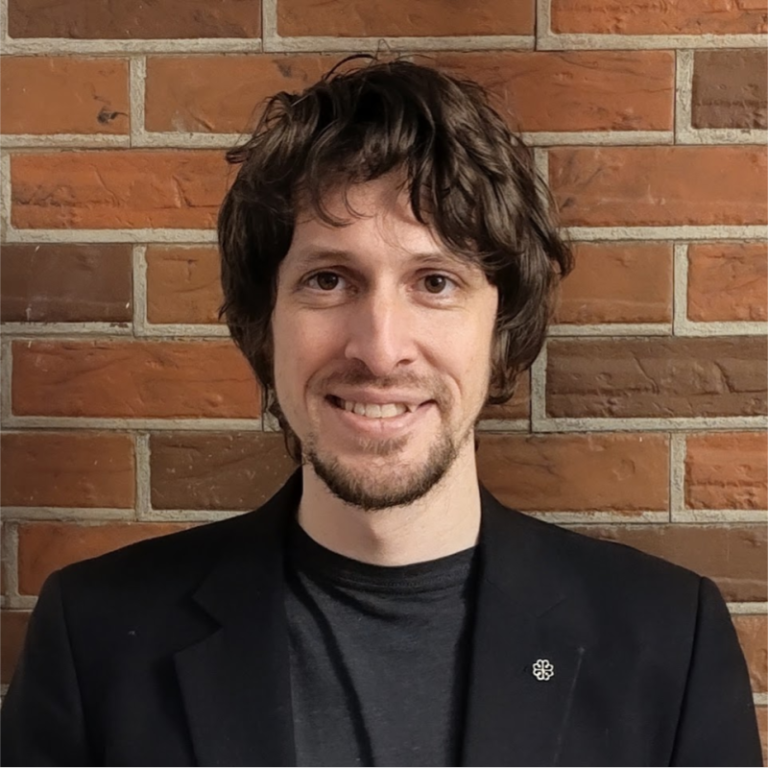
Generative AI is the most complex technology we’ve built, yet it seems very easy to use. But if you don’t know how it works, you don’t know why it might fail, or what damage it could do… When literacy rises, the benefits will far outweigh the risks.
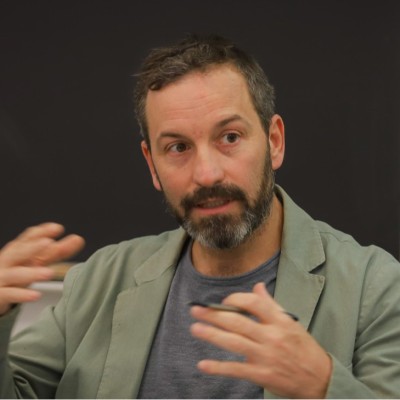
People in situations of vulnerability are always the first at risk when there are no safeguards. But we are humanitarians. We have never been afraid to jump into the unknown, so it’s time for us to step up.
Thank you to Patrick and Albert for sharing their reflections, and we wish Humanitair-IA/Humanitarian AI Lab every success as it grows. This interview was conducted to build on and highlight the impact of the Humanitarian Leadership Academy and Data Friendly Space Humanitarian AI 2025–26 research initiative. Supporting resources – including reports, podcasts, webinars and microlearning guides – are available on the research landing page.
Links
Generative AI in Canadian Humanitarian and International Development Organizations | Results of the 2026 national survey: what stands out and what it means for organizations
Humanitair-IA Lab (Humanitarian AI Lab) at OCCAH
You may also be interested in
A research perspective from Colombia | Humanitarian AI research in action: a humanitarian technologist’s view from Colombia
A research perspective from Türkiye | Humanitarian AI research in action: a humanitarian communicator’s view from Türkiye
Disclaimer
The views and opinions expressed in this interview are those of the featured individuals and do not necessarily reflect those of their affiliated organisations. This resource has been produced as a contribution to ongoing discussions on the use of AI in the humanitarian sector. Publication does not constitute endorsement of any specific technology, individual, organisation or approach.