15th December 2025
 Marina Kobzeva
 Ka Man Parkinson
How can solidarity transform humanitarian leadership to truly centre communities?
“Humanitarian aid comes with this inherent tension where you’re very grateful, happy to be seen, totally appreciate the kindness of people who owe you nothing and still choose to help. But also that humiliation and resentment at people sometimes missing the complexity of your context, and therefore flattening your own humanity to just need.”
– Marina Kobzeva
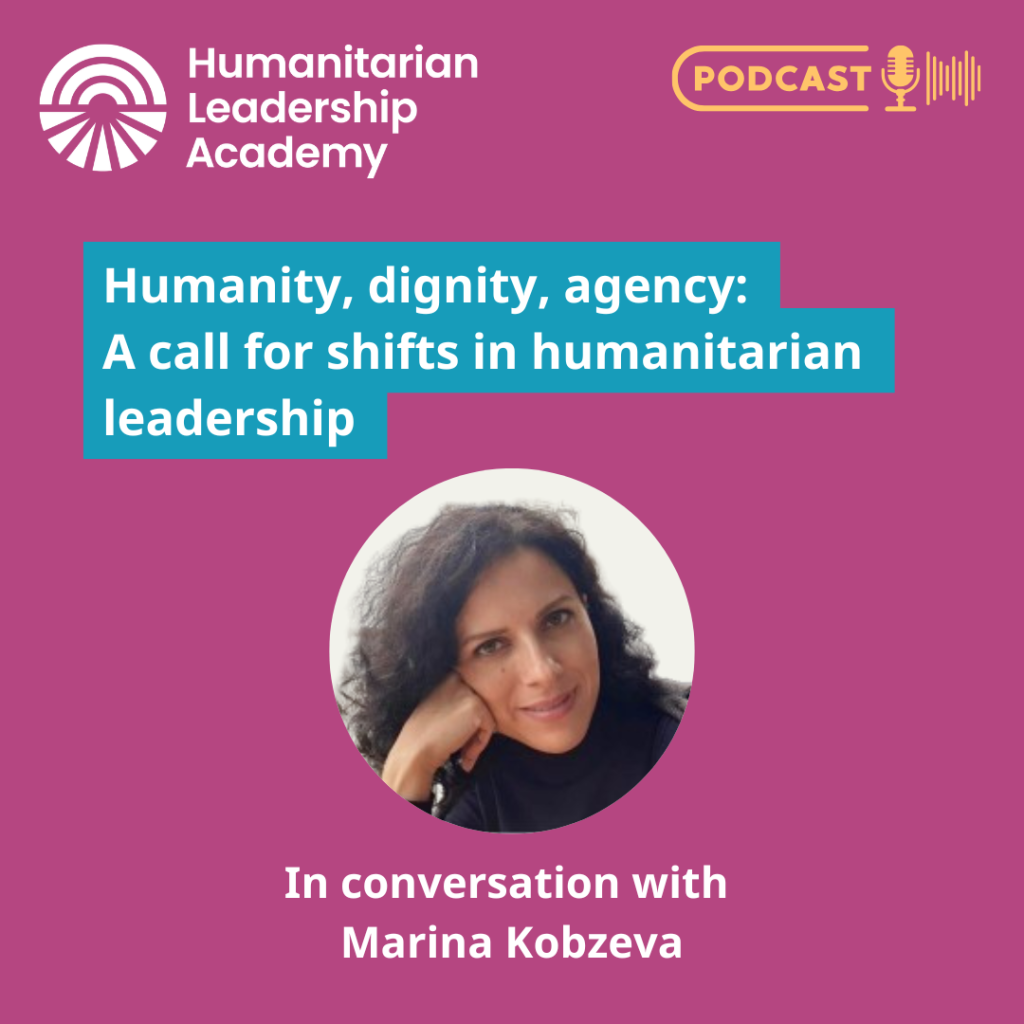
In this candid leadership-focused conversation, Marina Kobzeva speaks with Ka Man Parkinson about the humanitarian sector at a critical juncture – and the unlearning, reflection and change required of all of us.
Drawing on her lived experience and two decades as a humanitarian leader, Marina explores how the system “projectises” crisis, and why the most effective response is often led by communities themselves outside formal humanitarian structures.
Through powerful personal storytelling – from unnecessary chlorine tablets in aid packages to a small act of kindness that transcends conflict and division – Marina illustrates what solidarity looks like when stripped of bureaucracy. This is a conversation about unlearning, transformation, and the raw power of human connection.
Keywords: humanitarian leadership, humanitarian assistance, humanitarian reform, localisation, local leadership, lived experience, humanitarian learning, humanitarian dialogue, Civil Society Organisations, mutual aid groups, hyper local models, Resilio Fund, Pledge for Change.
Chapters
00:00: Chapter 1: Introduction
04:38: Chapter 2: “Flattening your own humanity”
12:19: Chapter 3: “Technocratising solidarity” – the need to centre communities and local leadership
28:50: Chapter 4: Lived experience as an “immunisation”
39:25: Chapter 5: Challenging conversations, unlearning and rebuilding with solidarity
45:37: Chapter 6: “It’s one of the things giving me hope” – locally led humanitarian action
59:49: Chapter 7: An expression of solidarity: a broken gate latch and an unspoken gesture
66:52: Chapter 8: Marina’s closing reflections and hopes for 2026
The views and opinions expressed in our podcast are those of the speakers and do not necessarily reflect the views or positions of their organisations.
Episode transcript
00:00: Chapter 1: Introduction
[Music, voiceover, Ka Man]: Welcome to Fresh Humanitarian Perspectives, the podcast brought to you by the Humanitarian Leadership Academy.
[Music changes]
[Voiceover, Marina]: So I realised that humanitarian aid comes with this inherent tension where you’re very grateful, happy to be seen, totally appreciate the kindness of people who owe you nothing and still choose to help. But also that humiliation and resentment at people sometimes missing the complexity of your context, and therefore flattening your own humanity to just need.
[Voiceover, Marina]: That power of solidarity, you know, it stayed with me. It’s one of the highlights of my year [laughs], that fixed latch by the workers next door…
And I think that a lot of what people do for other people comes from that place. It doesn’t have to be mediated by the sector. Or the sector needs to be…adjust, transform, and align with taking that raw power of solidarity.
[Voiceover, Ka Man]: I’m Ka Man Parkinson, and welcome to the final episode of Fresh Humanitarian Perspectives of 2025. With the deeply challenging year that has unfolded, our aspiration is that this podcast has provided a space for humanitarians to share, help make sense of and process some of this change together. It’s been a real support to me personally and I hope that some of the conversations have resonated with you too. On behalf of the Humanitarian Leadership Academy, our deepest thanks and appreciation to everyone who has joined in this space as a guest or listener. Solidarity has been a key theme that has emerged throughout the conversations with the team and me.
So, I’m delighted to bring this final instalment with Marina Kobzeva, a seasoned humanitarian leader, which is a powerful and fitting close to this season. A gifted storyteller and passionate advocate for locally led humanitarian action, Marina takes us on a journey from her own experience of receiving humanitarian assistance to moving into the professionalised humanitarian sector, while highlighting the at times challenging and confronting lessons learned along the way.
Dignity, solidarity and change are themes that surface in this conversation, and Marina invites us all to reflect and unlearn some of our embedded practices across the sector, and to shift to ways of working that really centre people and communities.
[Music fades]
Ka Man: Hi Marina, welcome to the podcast!
Marina: Hi Ka Man, thank you for having me.
Ka Man: I’ve been really looking forward to this conversation with you today, eagerly anticipating what will emerge because I’m a keen follower of you on LinkedIn. I love seeing your posts, so much of it really resonates, and I love how you don’t shy away from examining challenging areas across the humanitarian sector and beyond, so thank you for making this time to speak with me today.
Marina: Exciting, thank you.
Ka Man: So, before we delve into some of the areas and topics around humanitarian leadership, would you like to briefly introduce yourself to our listeners, letting us know a little bit about yourself and what you do?
Marina: Sure. Well, thank you again. My name is Marina, Marina Kobzeva. I’m the Programmes and Partnerships Director for MapAction. MapAction is a small, UK-based INGO, charity, that works on data-facilitated humanitarian decision-making, basically, in anticipatory action and humanitarian response, in preparedness, capacity development. And I sit on a couple of other boards, I am a Trustee of Christian Aid, and I sit on a couple of other boards and panels, in, you know, pursuit of my – I wanted to say a lifelong, career-long passion for quality and accountability of humanitarian aid.
Ka Man: That’s great, thank you.
04:38: Chapter 2: “Flattening your own humanity”
Ka Man: So if any of our listeners do follow you on LinkedIn, they’ll probably be familiar with some of your story and background, because you do share a lot about your own lived experience. But I wonder, for those who haven’t encountered you online or met you in person, would you like to share a bit more about that today?
Marina: Yeah, sure, thank you for that. My journey into the sector started when I was nine. And my family lived in by then already collapsed, Soviet Union. And at some point in time, we received humanitarian assistance. I had no idea we were in a situation that would require humanitarian assistance, but then again, I was only nine, so, I know that my parents don’t look with fondness back on these years. So we received assistance, we dived into those boxes with, you know, foreign writing, were completely swept off our feet by the kindness of strangers, that’s what it felt like. I remember we couldn’t figure out the language, and our dad had told us it was German. And we went to the map. We always have maps in the house, so I guess MapAction was sort of written in the stars for me. In every room, you know, maps, and we went to the map of the world. And I remember tracing the distance between Germany and where we were on the border with Iran, and thinking, wow, people all the way there thought about us. This is amazing.
And I don’t know if that really was the most formative experience that later made me consider this sector as the sector to work in, but eventually, that’s what it ended up being. I’ve graduated from university, and after six months in corporate world, working on a Corporate Social Responsibility Project, joined the International Federation of the Red Cross, and have been in the sector for, I don’t know, 19 years now.
So it’s been, it’s been a while, and yeah, I’ve worked in different parts of the sector. And pretty early on, I realised that I wanted to work on things, projects, approaches that centre communities. Humanity. Agency. Dignity. Because what I didn’t share about that experience of receiving aid was that some of the items that those boxes had were also indicative of the fact that those people who sent them didn’t understand our realities.
And I know it felt demeaning to my parents, it was just interesting to me, but my parents, through looking at those, you know, chlorine tablets that were part of the boxes. I remember overhearing the conversation in the kitchen they had after we presumably went to bed with my brother, saying, where do they think we live? We have running water, we have safe water. I know my parents, my mum would sometimes have to start queuing for bread, you know, at 5am, or my dad, I remember leaving in the night and coming back early in the morning because he had to go to the bakery and wait until it opened, so things weren’t that easy.
But yeah, there were so many things that were not a need, that were not seen by the helpers, so I realised that humanitarian aid comes with this inherent tension where you’re very grateful, happy to be seen, totally appreciate the kindness of people who owe you nothing and still choose to help. But also that humiliation and resentment at people sometimes missing the complexity of your context, and therefore flattening your own humanity to just need.
Ka Man: How did that moment and that reflection, it sounds like it impacted on you and stayed with you. So how do you think these experiences and what you’ve just shared have shaped you and your values as a humanitarian leader?
Marina: I think one of the issues that I’ve come across as I was in some rooms with other humanitarians from the Global North, the majority world, is that we, many of us, share these experiences. And at first, when I shared it with the first group of people, I felt slightly embarrassed because, you know, receiving assistance immediately puts you in a certain category, where you… you know how dehumanising the narratives about people in need can be, how simplified down to, basically, poverty porn, they might sound. And you don’t obviously want to be part of this narrative, right?
But on the other hand, I remember once I first shared and almost, you know, waited for the room to react, and many people said, I did too, I received it too, etc, and we sat and we talked about, and I think it was the first time that I reflected on whether it actually really had any profound effect, impact on me.
And we agreed that, that yes, it… as much as you might want to forget it, because it’s definitely not the highlight, you know, of your life, not the experience you want to be dwelling upon too much, it shifts something in you, right? Because having been on the receiving end of it, you get this, I don’t know, kind of this lived experience immunisation. Which does not necessarily mean that you won’t dehumanise or simplify others, but it reduces the chances of it happening dramatically. And that’s, I think, where my passion for centring people’s dignity for humanity without infantilising, without, you know, stereotyping, without turning people into just numbers and needs, comes from.
And yeah, that’s what informed my, I don’t know, career progression and things I work on, and that’s why I write what I write on LinkedIn, constantly bringing focus back to people in the crises and the contexts where humanitarian aid is present, or should be. And so centring the humanity of people in need of assistance, and those closest to them providing it, whether we are in the picture, we, by meaning international bodies, whether we’re in the picture or not.
12:19: Chapter 3: “Technocratising solidarity” – the need to centre communities and local leadership
And I, I don’t know. I feel like I’ve gone through several inflection points throughout my career, where that became more visible to me, or I became more and more aware of it. How the system works. How easy it is to start treating people like numbers. How easy it is to start projectising complex situations.
I remember when it was, I think, my first year with the Red Cross, something, a serious emergency, man-made emergency happened in Siberia, right, I was based in Moscow at the time in the office that covered, you know, Ukraine, Moldova, Belarus, and Russia.
And the communities that were affected by the emergency, I think it was the burst hydropower plant dam. They, those people, they were so shocked by what happened, and I remember thinking, I don’t even know where to start, what to do, what the needs would be. I knew the government was also active in supporting the families in some way. What could the Red Cross do? And I could see how some of my more experienced colleagues, they immediately had a project in their mind, okay, we can do the psychosocial support here and there. And, and while it was an incredibly useful learning experience for me, I also saw how quickly an emergency, somebody’s tragedy, somebody’s worst day of their lives, turns into a project, into a budget, into a proposal.
And whilst it’s often very necessary, it also somehow technocratises the solidarity, you know, the pull you feel inside to do something. And the more such situations happened, and obviously, at the time, it was early 2000s, there was a tonne of similar emergencies in that region, because all the post-Soviet infrastructure was crumbling, and, you know, there were boats sinking, planes falling, house, you know, fires raging, you could see how it almost becomes a knee-jerk, you know, reaction. Okay, this happens, okay, we do this, like, it’s basically, it activates a flowchart, flow diagram in your head, if then, you know?
And I realised that on project number 10, you stop connecting with the… with what happened. Possibly to protect yourself, but also it becomes almost automated, you know? Things were automated way before AI entered the chat, you know? And that automation, whilst it does provide some resources to communities often, at the end of all this project proposal, etc, it also creates these loops where people affected by crisis are more and more excluded, because you already think you know what they want.
And I remember that was the first, that, that inflection point. And then the realisation that, you know, I was the local staff member, right? And around me were many, well, a good few expats who had lifestyles I could never dream of, right? And in my own capital, who… at least not dream of whilst still staying in the sector, who had the decision-making positions. Obviously, I was just two years out of university, I didn’t expect to be the country director, don’t get me wrong. But what I was quickly told, that I could never be a country director in my own country.
And I remember asking why, why that was, and I was told, well, that’s because, you know, it’s to avoid tribalism. Because, you know, you would have vested interests, you know, you would be more aligned with certain social groups more than others, and we need someone in the position of neutrality, ethnicity has to be a foreigner, a foreigner who, with the best of intentions, probably will not have the same knowledge of the context, etc.
And I remember internalising it and thinking, okay, if I want to really have a career in the sector, I need to leave. I can’t stay in my own country where I could probably be the most useful, right? And eventually, I think it stayed with me, and when I found myself two jobs later in the Philippines, I thought, well, this is my time to be an expat now. This is my time to live in a nice flat, etc. But the problem is, that once you’ve been a local staff member, you can’t forget it. Working with local staff members in Manila, or in other parts of the archipelago, and you know they look at you the way you looked at expats in your office when you started. I can’t shake it off. It’s there, right? And you see the unfairness of the system that you’ve internalised play out again, just against other people.
And it becomes very hard to justify being part of it. So, so yeah, I think that, for me, that was another inflection point where you think, okay, maybe this system isn’t that fair between, you know, expats, locals, and maybe it’s not about, you know, oh well, if I race through the ranks, eventually I’ll be international. You get there, and you still realise that the system is still unfair, but only now it’s unfair to other people. And you can choose to do something about it, and it also translates in how you deal with local partners, right?
When I worked in the Philippines, we had a number of local partners, and to become eligible for that partnership, partners had to complete a partner capacity assessment, right? It was an intense process, where you would lock yourself down with a partner for three days, go through endless questions about, you know, their governance, their solvency, everything. And a lot of the questions were fairly intrusive, not to mention, possibly not perfectly suited for the context, right? They were like, kind of Global North-shaped questions.
And I remember going through these questions, sitting with my counterpart from the partner organisation, and as much as she tried to contain her frustration, I could see that it was rising because she had 40 years’ experience in her own country doing emergency response for communities whose language she spoke. And there were we, you know, asking all these questions, and it was embarrassing, you know? It was embarrassing, and to be, to be the channel of, of that, that line of questioning, and yeah, that was another, you know, moment where you think, wow, surely it can be done differently. This is… this, this, this feels wrong, you know? This woman knows what she’s doing, and all other partners do too, and communities trust them. How is that not included in our due diligence, you know, questionnaire.
So, so yeah. And I don’t know. I’ve worked for over a decade on all things humanitarian quality and accountability, you know, standards, the Core Humanitarian Standard, Sphere, others, HAP – that was before the CHS – and I always thought that, you know, I had communities’ interests in mind. But eventually started thinking that local partners are somewhere, they’re lost somewhere in the middle, where a lot of that burden of meeting the standards that have not necessarily been developed in collaboration with local organisations and local communities. But the burden of complying with them, it’s often pushed onto those local organisations that are already stretched to capacity, right?
And I remember a couple of years ago, on my work trip to Zimbabwe, at the end of a focus group discussion, where we sat down with local small holder farmers to talk about the projects that were implemented in the community by the local partner, and to see, you know, if quality and accountability commitments were really acted upon. I asked them, because we had some time left, and the car that was supposed to take us back to the capital hadn’t arrived, I asked, do you, are you happy with how things went? What do people like us, local, foreign, who come and want to help? What should they do? You know, I always used to think that the humanitarian standards that are there, they are there, the source of this truth, right, of what communities want.
And that the communities are probably too focused on survival, on the daily routines, on, you know, the immediate needs to be having such deep conversations about what I felt was an abstract topic. And those men proved me wrong immediately. They came back to me with a tonne of incredibly useful, sophisticated, clearly thought through ideas as to what communities wanted when someone came to them and offered help. And there were things like climate change, right? They said the climate is changing, our seeds are no longer, you know, withstanding the changes in weather patterns, or if you’re implementing livelihood programmes, check the land rights first, because a lot of the land we’re working with is not ours. We’re not feeling safe if our livelihoods are tied to, you know, agriculture. Don’t bring your assistance in plastic because it pollutes the environment. Talk to our local government. You don’t always do that, and it puts us in a weird position with them. And a lot, a lot of other similar suggestions.
And I remember walking away from that conversation thinking, wow, I’ve always considered myself an advocate for, you know, communities being centred, their dignity being centred, their agency respected. I never actually asked them about any of that. And through this journey, I feel like, you know, I’ve learnt new things, but I’ve also unlearned many things and understood that when you’re in it, in the system, in the sector, whatever we call it, you take its shape, right, and you become complicit with some things that you don’t even know you’ve become part of, you know, and so, so yeah.
I’m just going to probably stop here, but if I look back, I think these would be the key points when, that stopped me in my tracks, and I thought, wait a second, I thought I knew what I was doing, you know? I thought I knew what my mission, what my ideals, my hopes, my dreams, my purpose were. And then one interaction, one conversation, stops you in your tracks, and you think, wow, there’s so much I still don’t know, there’s so many things I’m doing wrong whilst thinking that I’m upholding and centring the dignity and agency of communities.
Ka Man: Marina, thank you so much for that really candid and open reflection, which was very powerful. And I think is really important for others to hear, your personal experience as an individual, and everything that you’ve experienced, and all of those probably what, how you describe, quite a difficult self-reflection at times, where you’ve looked back and thought, why have I, why did I approach it like this, and how come I didn’t ask that question, and… I think we’re at a point where everyone in the sector, no matter where you sit, has to, we have to do that reflection, even what you think as small, everyday administrative tasks like, what, how are we approaching this? And, you know, just really look into ourselves in the way that you do.
So I think you sharing your reflections acts as an invitation for all of us to do that, no matter where we are, because you’ve described things that seem really small, in inverted commas, that actually do have big implications for people. Going back to when you talked about the chlorine tablets, and talking about this sense of gratitude and being seen, but at the same time, also this – what? Why? Like, confusion, and then realising that this was meant for a completely different context, it’s not, not for you. So, that duality exists, probably, with everybody in the sector.
I thought it was really interesting how you say that lived experience can act as a vaccine, but it doesn’t make you completely… doesn’t guarantee immunity to this. And you’ve talked about projectising and creating these… being part of this system and processes that end up inadvertently causing harm, or negative impacts.
As you’ve been talking, your reflections really align with a lot of the reflections shared by one of our previous podcast guests, Ali Al Mokdad, who talked along similar experiences, he talked about his own lived experience, and then examining the system, the power imbalance between local staff, international staff, and seeing interventions that weren’t designed for that context, and that it seems like a small thing, it’s like, well, there’s good intentions, so what’s the problem? But actually, it can stay with people and have a profound impact at a time when they’re experiencing profound challenges in crisis, so it’s not… it’s no small thing and shouldn’t be minimised. So, thank you very much for that, and you’ve made me reflect a lot, too.
28:50: Chapter 4: Lived experience as an “immunisation”
Ka Man: Just to pick up on the vaccine [laughs] kind of concept. If we want to bring the humanity back into our work, if we want to take these burdensome and, at times, harmful processes, dehumanising, certain assessments that might not be appropriate, etc. If, if lived experience can support with centring communities and individuals, how can people across the sector, how can we, how can we begin to do that if there isn’t that lived experience to draw on? There may be that empathy and compassion and good intentions, but aren’t in that space to directly draw on those kind of feelings and experiences that you’ve talked about. How do you… how do you get that vaccination across the whole… and bringing that humanity. I wondered if you’ve got any thoughts on how we can practically do that? Is it up to individuals who are passionate about this, is it within INGOs, for example, in the Global North, to advocate and educate, or is it that we all have to do this work ourselves? Yeah, so I don’t know if you have any thoughts on that.
Marina: It’s a great question, and I, I don’t know where to start, because I have two ideas, running, you know, in opposite directions about how that can, can be done. And one of them says, well, you know what? People with lived experience have been excluded from a lot of decision-making spaces, you know, tables, rooms, and it’s about time they took the centre stage, and by people with lived experience. I don’t mean someone like myself, who, you know, got just had one-off experience of that, of receiving aid. Okay, I was local staff for five years, but I’m talking about people with lived experience in the places that currently experience high levels of humanitarian need, right? So people from those contexts who are currently in it. Why don’t we bring them, not in a tokenistic kind of way, not, like, one person from the majority world per panel, but, you know, why don’t we finally have panels made exclusively of people from those contexts, and not just panels, but, you know, places where real decisions are made, right?
So, on the one hand, I want to say, lived experience can’t be learned, right? And people with lived experience need to be in the positions of authority, decision making. But on the other hand, I also know that I’ve met a tonne of people through my work and life with absolutely genuine commitment to solidarity in the sector and outside the sector, doesn’t mean that these people have no space, no place to act on it, right? And I think it would be unfair, and that’s my second idea, right? Running in the opposite direction. How do we not fight exclusion with exclusion, right? How do we look at whatever strengths, I don’t know, gifts, opportunities that our respective positionality brings for the benefit of a more fair, more solidarity-driven… well, world and sector in, you know, in particular. What can we do with our own governments? How can we advocate with taxpayers, right?
For example, I’m hearing all the time that the legitimacy crisis of the humanitarian aid sector is not only unfolding in the majority world, it’s unfolding here. I’m based in London, for example, right? And presumably the British public have generally lost not only trust, but also interest in international development and humanitarian assistance, because there are many problems at home, right? And why help there if help is needed here? And there are many negative narratives around the sector circulating, many completely, you know, representing the rumour mill, the untrue, fake news, etc, and many that have some truth to them as well.
So how can we work within our own contexts for the benefit of the parts of the globe where humanitarian assistance is still needed. Can we work on justice? On debt forgiveness. On reparations. On working with our, the constituencies where we live on fundraising. On convening. On countering dehumanising narratives that normally are the starting point before the communities here in the Global North lose interest in supporting, you know, people in need over there and start fearing them coming over in small boats, you know?
I think there’s plenty for all of us to do. I look at things like expat roles, for example, right? And even though I myself was in that position twice in my career, and I know some people told me, oh, it’s easy for you to say, you’re inside the sector, or you are inside the sector, now you’re criticising it, even though you owe a lot to it. And I do. I do owe a lot to it. But, for example, yeah, this division between expats and locals, it needs to die, right? So I think anyone who has should have an opportunity to contribute to our shared, you know, prosperity, wellbeing, peace, but possibly not with an expat package, you know? Because I think these, exorbitantly expensive benefits, they pull people into lifestyles that are hard to leave behind, that you get used to them. We get used to things, right? It’s a human thing.
And I’m not saying that people who have got used to those types of lifestyles are now not moved by the suffering or indignity in the context where they’re based. But I think there’s just something so deeply wrong and colonial about it. And I am yet to find a context, and I’ve travelled to many, many countries and lived in a few, where there’s a shortage of qualified local people with the knowledge and insight on how to best address the problems in their contexts.
And this approach, that, you know, we need a foreigner to avoid tribal, you know, tribalism, and to ensure neutrality, I think it’s such a tired trope, and it needs to really, we need to start phasing it out, also because, let’s be honest, we have far less money to afford such expensive setups as a sector, don’t we want this money to go as far as possible?
Because I know very well that my neighbour here in London, who makes jams and then sells them for £5 a jar and then donates all of that money to one of the British INGOs, she expects that quite a bit of that will go to the communities affected by crisis. And sometimes I chat with her, and I think, if only you knew that, yes, quite a bit of it will make it to the communities, but not as much as you think.
And I think, these are the uncomfortable questions that those of us who are working in the Global North in Global North institutions need to start talking about. And it’s hard, because it affects us personally, right? It affects our livelihoods. And it affects our identities, because obviously the sector is very good at giving us an identity, an identity of a good person, an identity of a person who cares. Some people say to us, oh, you’re such a hero, thank you for doing that, and as much as I think we normally push back on this, it’s like, oh, no, no, it’s the local partners, they’re doing all the work, etc, it’s intoxicating.
And I, I think that we need to have that honest conversation with ourselves, by ourselves or not? I don’t know, going back to your question. Not necessarily. I think if we just get less defensive about these things we’ve internalised and have become part of ourselves and actually really listen to what local partners say, what communities say, what people with lived experience see, we don’t have to go it alone, because I think it’s, I mean, come on, capacity development has always flown from the global north to the majority world, right? It’s about time it started flowing in the opposite direction, because we still have a lot to learn, too.
39:25: Chapter 5: Challenging conversations, unlearning and rebuilding with solidarity
Ka Man: Well, thank you very much for sharing that, Marina. It’s, there’s a lot for us to reflect on, and it made me think about how this week we held a Humanitarian Xchange panel discussion which was called Humanitarian Futures: Still Here, Still Human, What Next? And that was really, we had a diverse panel, and we had people from across the ecosystem like you’ve talked about, country director from the US, based in Nigeria. We had scholars like Themrise Khan, who advocates for the end of aid.
So obviously, really occupying very different views and vantage points. But we were able to come together in this space and have that kind of surface those views, and it was respectful, and it was, we were all trying to understand where each other was coming from, and there was a lot of common ground there, so it was actually quite powerful for me to watch, because none of the speakers were, like, flinched or I couldn’t see their hackles going up, if you know what I mean, when their positionality is being called into question, because everyone there wants to be there, because they want to, because of the solidarity, really focusing on the humanity, not about titles or you know, any of that. So, a lot of what you were sharing really resonates.
And I think one of our panellists, Angela, from HumAngle Foundation in Nigeria, she said that we as a sector have to evolve, we have to collaborate, but what that collaboration looks like has to evolve. And she says that we’re at a precipice, and I couldn’t agree more. I think we really are, I really sense that across every, everyone that I’m speaking to, what I’m seeing and hearing. I really think that no matter what, where we are, what our views are, our positionality, we recognise that.
So really, it’s the time for us, like we were talking about earlier, to have those difficult conversations and reflections with ourselves from those micro, in inverted commas, actions, the business as usual, inverted commas again, through to bigger, bigger changes and more wide-ranging reforms. Hiring practices, for example, was something that you signalled there.
So it’s, what I’m really hearing from you, Marina, and the panellists this week, is that we have to approach this with that humility, and it’s not about, we can’t be defensive. There’s obviously a lot of brilliant work, incredible work that’s being done by people from all across the sector, so it’s not about tearing that down, but it’s about those problematic, challenging, difficult things that you… some of those things that you’ve already alluded to, and some things that are really harmful, and have to go. So that’s the message that I take from you there, Marina.
Marina: Yes, thank you, and I’m… it’s such a shame that I missed the event that you referred to. I will watch the recording. I do mean that, I also understand that it all comes across as… I don’t know, me preaching from a, from, like, you know, some moral high ground, and that is absolutely the last thing I want to come across as, you know? Because I think, I’ve, a few months ago, I wrote a post, you know, how as an international development, humanitarian, international humanitarian worker, you go through stages, right?
Like, where you’re the saviour, the expert, etc, the, you know, the person who believes that, well, nothing can be done, I’m not making the rules to, like, advocate and to ally, right? And I, someone told me earlier, that, you know, you can’t call yourself an ally unless people you’re trying to be an ally to call you that. But I’ve been at every stage there, so that’s why what I write about, I write from personal lived experience. I don’t do, you know, this deep humanitarian analysis, number crunching, etc. There are plenty of brilliant people out there, on LinkedIn included, who do it so much better than me. I write from the lived experience of, you know, this is what it looks like when you’re there. This is what you, what it feels like, you know, from a tiny little micro, as you said, you know, interaction, a dialogue, a situation, a day.
And I just want to say that this unlearning, etc, if, I mean, if I can do it, and I’ve gone through my waves of defensiveness about, like, oh, this is not it, like, this is not what it looks like, you know? It’s not what it looks like. Everyone can, right? And yes, of course, there are many real things that come into the picture here, like, again, livelihoods, identities, etc, and this perception that we are the good guys, right? Like, we are… we are the good ones here, we are helping other people, we are not some, you know, billionaires or politicians only worried about being re-elected.
So I think we have inhabited that space where we are unquestionably good for too long, for our own good. And it’s uncomfortable to recognise it. And I’m not saying that I know how to make it comfortable. But yeah, listening to those people from the contexts where aid is still happening, or is needed, is possibly the best way to work through that discomfort, and to finally not focus on what I want, what makes me feel good, but what is important in that context? What quality and accountability looks like? What good looks like to them.
45:37: Chapter 6: “It’s one of the things giving me hope” – locally led humanitarian action
Ka Man: Absolutely. Just picking up on your point around accountability, what does that look like, what is good, and unlearning that, what you’ve learnt, maybe, around that, and what that looks like, and looking ahead.
So I know that you’re a vocal proponent of locally led action through your roles and through, obviously, what you’ve shared here with us today. And I know that you, on LinkedIn, you’ve talked a lot about, about this, with specific examples, things that you’ve seen, things that you’ve been hearing about. I know that you’ve engaged with civil society dialogue, you went to Bangkok recently, you were talking on… about hyper-local models and other developments like this. So I just wondered if you could share a bit of your thinking around this, how this looks for you at the moment.
Marina: I think it’s one of the few things that’s giving me hope during this unprecedented year, you know, we call every year unprecedented, but this one has really been, you know, it really takes the cake.
We went to Bangkok with my colleague from MapAction to talk to a couple of partners, who we knew were going to attend from the broader Southeast Asian region. I’m not at liberty to name them because of the difficult political contexts where they work. And to also see how what we do, you know, data and mapping facilitated decision-making in emergencies can be useful. Can it even be useful, you know? Is it something, or are we a solution looking for a problem?
So we went there, completely open-minded and slightly out of our comfort zone, to talk to local CSOs. There were organisations from all over the world attending that International Civil Society Week, which was hosted by CIVICUS. And what we realised is that when you start talking to a local organisation, to a civil society organisation. I mean, they all were local, more or less, in their own contexts. You say humanitarian response, and… people glaze over. For them, humanitarian is something huge, coming from the outside with this, impenetrable systems that are hard to understand, that speak their own language, etc.
And it was quite hard to connect, just using, you know, the word humanitarian, which is funny, because this is the word I’ve used to describe myself for the last two decades, right? And then you talk to people, and they’re like, yeah, we don’t do that. This, this does, this really not, it is not my thing, it’s not our thing. But then you start connecting with them, and you know, some of those organisations were not from the global majority countries, but from the Global North as well, right? And that was a unique place where a lot of local organisations, they were local in different places, but there was no division between, you know, the Global South versus Global North, because they were sharing very similar problems, issues they were having across the board, whether they were in Europe and North America, and Sub-Saharan Africa, and Latin America, you know, or Southeast Asia, or elsewhere. The issues they’re working on, including the, you know, shrinking civic space, are universal, fairly universal across the globe.
So when we started talking to them about what it is that they do and what they do when an emergency strikes. Wildfires, you know, floods, anything else? They start telling you that, you know, they set down their tools, whatever they’re doing normally, and of course, they help their communities. They do what they can. They mobilise diaspora, they mobilise church, mosques, resources, the social capital that’s always obviously present in communities. And they do what they can. They support, they do humanitarian response, basically, right? They just never call it like that. They never call themselves that, and they never call what they do humanitarian response, but ultimately, that’s what they do. And then we started talking to them, not in a way that, you know, we’re just desperately trying to sell ourselves to them, but to understand whether what we are doing actually has a, has a place, right? It doesn’t have to, but it’s good to hear it from the horse’s mouth, right? And when we describe what we do, the products that we create, the accompaniment, the support, the, you know, revealing of bottlenecks in the ways in which data, for example, flows from one institution to another, and that enables people to anticipate risks, prepare for them, know where the most affected people are, how to get to them, etc, we got an overwhelming number of business cards, interest, and let’s connect, let’s talk about it.
Because when you talk to people in the language that they speak about things they care about, not about whatever service that you are, you know, best placed to provide, the alignment, that alignment is much more likely, and I realise that a lot of the people, the majority of the humanitarian response that happens in the world, it’s not done by the conventional humanitarian sector.
It’s done by those local organisations, civil society groups, human rights defenders, even in those contexts, when things start to deteriorate, and they activate those capacities, mutual aid networks, all of that system, you know, the original humanitarianism that was there since the, I don’t know, the dawn of times, way before the official humanitarian machinery rolls in. And sometimes it never rolls in, but local people activate what they have. They, you know, raise diaspora resources from abroad, they support their own, and it’s, there’s quite a bit of hubris, I think, amongst ourselves as the conventional humanitarian sector to call that work marginal, right? Like, oh, there are new things emerging on the margins. No, they’re not on the margins. They are the, they’re the main show. They always, they always have been, they always will be. And sometimes, it gets, supplemented, I want to say, but often, you know, just really pushed aside by the official humanitarian sector when it arrives to a location.
And I think, the mutual aid networks that were also present and that conference, the folks from the now-famous emergency response rooms in Sudan, right? And other similar networks and initiatives, globally, it looks like the sector has just discovered them, right, last year. Like, mutual aid has become the new, the next, the next blockchain. I don’t know what… and I don’t think it’s a fad. I think it’s great that it’s being recognised.
My only fear is how can we make sure that these traditional Indigenous systems of solidarity, of mutual support, do not get you know, projectised, co-opted, institutionalised by the sector. So how does the sector become more agile, flexible around these systems, without trying to fit them into our own world, you know? But ultimately, what made me very hopeful is that those people are here, I mean, there, and here as well in the UK, they’re working, they’re raising funds, and they are aware of the aid cuts, but they are not, you know, they’re undeterred.
And having attended the launch of the, you know, this new philanthropic initiative, the Resilio Fund, that seems to be the first ever initiative that wants to allocate resources directly to local communities in crisis, it seems that, you know, the momentum is there. Different funders, possibly mainly philanthropic ones, but not only, are recognising the power of communities taking care of their own, and this is what makes me… makes me hopeful, that as the official humanitarian architecture is… in decline, possibly slightly in denial about its place, its scale, its role and its future, there are other systems in place that have always been there, always will be.
And if we want to continue to channel that solidarity that brought us all here to this… to this place, how can we do that to support them, those who are already there, without, you know, strangling them with due diligence, with unsolicited capacity building, and trying to make them fit the mould of an INGO that we’ve, you know, designed. So, so yeah, that’s my, that’s my hope, and that’s my fear. Will these mechanisms be co-opted, or will they be supported in helping the shrinking humanitarian funding go further and reach those most in need in those contexts that need it the most.
Ka Man: With developments like the Pledge for Change 2030 and the Resilio Fund, do you hold an optimistic view about the course in the coming years? Or are you… cautious? What’s your, what’s your gut feeling on this?
Marina: I’ve, you know, when I was speaking about this pivotal moment, right? I didn’t mention the last one that I think we all had earlier this year, the aid cuts, right? And I think it was pivotal, not because it’s, I mean, the whole sector has had the, you know, has had the rug pulled from under, from under them because of what the organisations chose to do as a result of that, right? And I’m currently looking for stories where the Global North-based organisations chose to not turn inwards, focus on self-preservation. There are not many examples, but they do exist, right?
And so to answer your question, whether I’m optimistic. I am optimistic. I am eternally optimistic. I even, I don’t know, I wrote a post once that, you know, why I criticise the sector. I criticise it because I love it, you know? Because I love its potential for beauty, for solidarity. And it’s all I’ve ever known. It’s my… it’s been my home, right? I’ve moved a lot, and that was my only home, proper home, for the last two decades. And I care about it. And I… I believe that there are enough people who care about it, too, to make sure that it adapts to the changing times, to the changing funding patterns, of course, too. Need to acknowledge that this is an objective reality we are living with now. I believe that the role of INGOs, of the multilateral system, will need to change significantly for them to remain legitimate.
But whether the sector will still be, you know, kind of fronted by those institutions, or, as I would prefer, by local responders who don’t call themselves ‘humanitarian’ 95% of the time, I believe the sector will survive. Because, you know, the power of solidarity, it’s just a human thing, and we might change the way, the ways we mediate it, you know, that solidarity, that shared humanity between us and them?
Or how do we stop dividing, you know, between us and them? And I just don’t know.
59:49: Chapter 7: An expression of solidarity: a broken gate latch and an unspoken gesture
I wanted to mention that solidarity is not just, you know, here or there, right? It’s not… between the Global North and Global South. It’s something that happens all the time. Often it doesn’t need the channels that have been… or the systems that have been built to channel it, and if the current humanitarian system will change, or will collapse, or will shrink into irrelevance, the solidarity will still remain, and I know it’s potentially sounding naive, because, you know, all the right-wing movements and shift and global North, you know, political trends, as to, you know, towards isolationism, etc.
But you see it amongst people all the time, and for fear of sounding naive and extrapolating a small event onto something much bigger and, I don’t know, more global. I just wanted to share one tiny example of that. Because I’m, I’m sat here in front of my window, and I can see how my neighbour’s next door are extending their loft. I mean, the neighbours themselves are not here, but the workers who have been around here for a few weeks now working on the neighbours, the workers, sorry, they are a mix of Polish and Ukrainian men. And I am Russian, right?
I try to speak Russian to my children to make sure that they speak it. We’ve not been back in Moscow for years, since before the war in Ukraine escalated. And I’m not planning to go back until it’s over. It’s not completely safe to go back, right? I know that my speaking Russian is grating for them, for the workers next door, so I try not to speak loudly in the yard, in the garden, so they don’t hear me, but you know, I have a two-year-old, and sometimes he just, you know, rushes into the road that we have in front of the house here, and then I run after him, and obviously I’ll raise my voice.
So basically, the neighbours, workers, they know, they know who I am, where I’m from, they know perfectly well. And we’ve just been exchanging some, you know, dry hellos, until quite recently, when I was on another call. And I heard this commotion outside of my gate. And we have had this latch on our front gate falling out for months. We’re pushing it back in, and we’re not fixing it, because we think, like, okay, this weekend for sure, but then, you know, the weekend comes, something happens, and we never do it, and we keep telling ourselves, okay, next time, definitely we’ll fix it.
So a couple of weeks ago, I hear the commotion, and I look outside the window, and I see that a couple of those men working next door are fixing my latch. I, I couldn’t just run down and thank them, because I was on the call. I was in a meeting, I was chairing. It took them three minutes to fix it. They didn’t need to do it, didn’t have to do it, right? They, like, all things considered, they had every legitimate reason to never want to do it.
When my meeting was over, I ran down and I, I rang the bell. They came out, and I said, did you just fix it? You know, they didn’t leave any logos, right? They didn’t give me any capacity building how to use my latch, you know, just parallels here. They just fixed it. They saw a problem, they had a solution, the goodwill, the resources, so they did it, right? And they’re like, yeah, yeah, no, no, thank you, it’s okay, you’re welcome, you’re welcome. That power of solidarity note stayed with me. It’s one of the highlights of my year, that fixed latch by the workers next door.
And I think that a lot of what people do for other people comes from that place. It doesn’t have to be mediated by the sector. What the sector needs to be… needs to adjust, transform, and align with taking that raw power of solidarity and channelling it in ways that uphold our shared humanity, rather than flattening the receiving end into a stereotype or just need or something else.
And for me, this example, and all my friends know about it, because I can’t stop talking about it, has been the single most inspiring situation over the last few weeks, because it shows you that even across legitimate grievance, legitimate reasons to dislike you, people can still choose to support you across difference, across conflict, across many other considerations. So, I’m hopeful. Will it happen? Will that solidarity continue being channelled through the existing systems? That I’m not sure about. But the fact that it’s not going to disappear, I see proof of that every day.
Ka Man: Marina, that is so powerful and beautiful, and you make me feel really emotional, it just really encapsulates everything that we talk about. The solidarity, humanity, it’s a simple… it was a very simple action for those, for those men. Three minutes, you said, it took them.
Marina: Maybe less. It was really quick, yes.
Ka Man: It was unspoken. It was just done, quietly.
Marina: They didn’t know I even… I saw them. They didn’t know I was looking out of my window as they worked. I just happened to, to know it.
Ka Man: Yet, no expectation. It’s just, this needs doing. I’ve got the ability to do it. I’ll just do it.
Marina: Without piling any extra, you know, processes, procedures, due diligence, capacity development on top of that, and if we just strip our… human… pull towards solidarity from all of that, not to mention that all those layers are also very expensive, right, to uphold. I’m sure we can support each other on this one planet we share much, much better.
Ka Man: Absolutely, Marina, thank you. Oh, wow, what a powerful conversation. Honestly, you really moved me with that reflection. And, in the context of everything that we’ve talked about, and in the context of this this year. So thank you. Thank you for opening up and sharing that.
66:52: Chapter 8: Marina’s closing reflections and hopes for 2026
Ka Man: Do you have any closing reflections to share to round off this conversation?
Marina: I would like to just say that, you know, I’ve, I’ve been told many times, all this talk, now do something, right? And I know that doing is, much more important than talking. But I also know that talking shifts Overton, the Overton window, right? It does shift that window. It normalises exposing certain things that have been accepted as unquestionable, non-negotiable, but don’t have to be. It lets other people come out and say the same.
And I just hope that we continue talking about the uncomfortable things, doing, too, obviously doing. But also creating spaces where we can come as, you know, as we are, in mixed groups from different positionalities, to share that, to listen to each other and to find alternative ways to coexisting and to making the sector that’s built on human solidarity work better. Work towards that. Not towards countries’ national interests, but towards upholding, you know, the upholding of the shared humanity. I know it sounds probably very idealistic, but hey, it’s almost Christmas time, right? You can make a hope for miracles in December [laughs].
So, yeah, I’m hoping for more open spaces, for more honest discussions, for conversations like the one that you had, and the one that I recently watched that was held at ODI, where justice-based and solidarity-based sector, sector’s future was being discussed. And it was so refreshing, and it was so brave, and I hope these brave conversations, which, of course, make us uncomfortable, happen more and lead to proper action, rather than us, you know, being just, locked away from the outside world in our jargon, in our acronyms, in our systems, losing relevance by the day, right? I think the humanitarian sector is one of the most opaque and misunderstood sectors from the outside. I want it to be more open to the outside world.
And I think that’s how it rebuilds its legitimacy. But also, by allowing, allowing that scrutiny from the outside world, it will be forced to address some of the inefficiencies, you know, colonial legacies that still shape a good part of it. So I’m hoping for, humanitarian sector fit for purpose. And yeah, this is what I want for Christmas, you know, amongst other things, so… so yeah. This is what I’m looking forward to seeing more of in 2026.
Ka Man: I do too, Marina, thank you. And I want to say also thank you for your advocacy, thank you for using your voice and your platform to use your gift for communication and storytelling to share your experiences, name things, like, surface those tensions, and contextualise it and make it easily understood, humanises the experiences. So like you say, the system can be quite opaque. Things are normalised, but you, you’re challenging that through, just sharing what you see, and just naming it. And I think as a sector, we need to do… collectively, we need to do more of that, not, and not be bound by… fear? We need to… just step into this… step into this space, because there’s too much at stake not to. It’s not business as usual.
Marina: Of course.
Ka Man: We’ve just got to… we’ve just got to just be, just be bold and brave in the way, yeah, and, and being open to that change. And a quote that’s always stayed with me, from Nova Reid in the Good Ally book around anti-racism, she says, you have to be, we have to be…get comfortable with being uncomfortable. And I think that applies here, too, for us, collectively.
Marina: Totally, I think we need to, maybe the bravest thing we could do and one of the most necessary ones at this point is to get out of the main character role that we want to play, and step aside and let others be the main character, those who have more credentials to be. And that’s, I think, how we continue being useful and do our part and support each other.
Ka Man: That’s a great place to bring this conversation to a close. Thank you so much, Marina. I think… it’s been incredible for me to speak with you, especially, this is the final podcast of 2025, and to hear your reflections, layered on top of all the other reflections that I’ve heard from different contributors over the… over the year. You’ve just really encapsulated everything. Human solidarity, and just being open to change, and learning, and really just, yeah, putting our best foot forward to, for, for yeah, for change, for positive change. So thank you very much.
Marina: Well, thank you so much for having me. It was such a pleasure, and an honour.
Ka Man: Thank you.
[Music]
Share the conversation
Follow Fresh Humanitarian Perspectives on your favourite podcast platform. Please consider leaving a review and sharing this episode with someone who may find it of interest. We welcome your feedback – please email info@humanitarian.academy
About the speakers
Marina Kobzeva is an accomplished humanitarian and development leader with nearly 20 years of experience in quality and accountability management, governance, organizational development, assurance, and risk management. She has worked extensively within the humanitarian sector at country, regional, and global levels, collaborating with prominent organizations such as the Red Cross Red Crescent Movement, the UN, and various international non-governmental organizations (INGOs).
With a strong commitment to building equitable and dignified partnerships, Marina has developed extensive cross-cultural expertise in engaging with national disaster management agencies, civil society organizations (CSOs), faith-based organizations (FBOs), and local non-governmental organizations (NGOs). She is a passionate advocate for shifting power to local actors and promoting systemic change within the aid sector.
Marina has a proven track record in formulating and executing strategies to enhance stakeholder engagement across the Majority World while embedding comprehensive quality, accountability, and risk management frameworks. Her educational background includes postgraduate qualifications in Education, Humanitarian Assistance, and Sustainability.
Residing in London with her husband and three sons, Marina continues to drive positive change in the humanitarian landscape through her dedicated work and innovative approaches.
Ka Man Parkinson is Communications and Marketing Lead at the Humanitarian Leadership Academy. With 20 years’ experience in communications and marketing management at UK higher education institutions and the British Council, Ka Man now leads on community building initiatives as part of the HLA’s convening strategy. She takes an interdisciplinary people-centred approach to her work, blending multimedia campaigns with learning and research initiatives. Ka Man is the producer of the HLA’s Fresh Humanitarian Perspectives podcast and leads the HLA webinar series. She is based near Manchester, UK.
Links
Humanitarian Futures: Still here, still human – what next? – Ka Man mentions the Humanitarian Xchange panel discussion in this conversation
Leading with vision and heart: reflections on humanitarian leadership with Ali Al Mokdad (part 1) – Ka Man mentions this podcast conversation with Ali Al Mokdad
Episode produced by Ka Man Parkinson, December 2025