13th August 2026
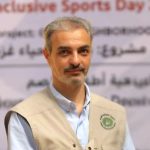
Fady Abed had barely settled into his new role.
It was September 2023, and he had just become director of the Atfaluna Society for Deaf Children (ASDC) in Gaza – an organisation with more than three decades of history serving people with and without disabilities.
A month later, war began. “I wasn’t even given the chance to get my papers in order as the new director,” Fady recalls. What followed was an immediate shift into crisis leadership, for him, his staff, and the more than two million people across Gaza whose lives changed almost overnight.
Supporting the community
To understand the scale of what people were facing, ASDC conducted its own field survey during the war, gathering data directly from the communities it serves. The findings pointed to widespread displacement, lost income, and limited access to basic necessities like clean water and food across Gaza.
For people with disabilities, the situation was compounded further. A large majority described the shelters they were living in as unsafe, unsuitable, and falling short of the minimum requirements set out under international conventions. Most also reported losing the assistive devices – hearing aids, wheelchairs, crutches – that connected them to the people and world around them.
Fady illustrates these figures with specific cases his organisation documented: a deaf child cut off from communication after losing a hearing aid during displacement; a family who never received an evacuation warning in a form they could understand.
“These figures are not mere statistics,” he says. “They are stories, suffering, and personal experiences that we have lived through alongside our beneficiaries.”
Proximity shaping holistic support
When the war broke out, many international organisations, including UN agencies, paused or scaled back operations, citing security risks to their staff. Local organisations like ASDC didn’t have that option, because their staff were part of the affected community themselves.
“We were displaced with them, we remained with them,” Fady says.
For Fady, this is the core distinction between local and international response: outside organisations tend to work sector by sector – shelter, water, protection – while local groups deal with whole human beings, whose needs don’t separate so neatly. Local organisations, he argues, are positioned to see those overlapping needs because they aren’t observing the crisis from outside it – they’re living inside the same tents as the people they serve.
That proximity translates into a direct, hands-on role: local organisations are the ones distributing aid and delivering services in the field, acting as translators who turn lived needs into a language international partners can act on, while working to ensure no group, particularly people with disabilities, older people, or girls, gets left out.
Beyond logistics, Fady sees something more symbolic in a local organisation simply continuing to operate under these conditions – a signal that beneficiaries haven’t been left to manage alone. He points to one image in particular: a person with a hearing impairment running a community kitchen that feeds hundreds of families. It’s not just a service being delivered, he says – it reshapes how the whole community understands disability and capability.
People with disabilities: leaders who shape humanitarian response
Within ten days of the war’s outbreak, ASDC’s teams – working from emergency plans built over years of responding to previous rounds of escalation in Gaza – were back in the field, offering services including sign language interpretation at distribution points and psychological support sessions, across Gaza City, the central region, and Khan Younis.
Before the war, the organisation employed around 135 people. Today, under Fady’s leadership, it employs more than 280, delivering integrated services to nearly 4,500 students with and without disabilities across more than fifty learning spaces in every governorate of Gaza.
During the war, ASDC received international recognition from the United Nations for its model of removing barriers to participation for people with disabilities. Fady frames the honour in a particular way: “This award was not so much a tribute to the association’s management,” he says, “as it was global recognition that people with disabilities are not merely recipients of aid, but are part of society – indeed, they are leaders who shaped the response.”
The costs and challenges of sustained support
This continuity has come with real costs. ASDC’s offices have been destroyed. Staff have lost homes, been injured, lost colleagues. Fuel, communications, and liquidity have all, at various points, been in short supply. “We had to start almost from scratch,” Fady says, describing a working methodology that shifted daily, which he compares to “a chess game,” recalculated to balance continued service against staff safety.
Funding remains a persistent challenge. Despite years of international commitments to channel humanitarian aid directly to local organisations, Fady says the share that actually reaches groups like his remains small, even as international agencies draw away trained local staff his organisation depends on to function.
Fady sees ASDC’s own survey work as part of this same argument for local leadership: the data it produced didn’t just document suffering, it became a tool used to advocate directly with international agencies and donors, grounding requests for support in evidence gathered from the community itself rather than external assessment.
“Nothing about us, without us”
Fady’s closing message to the humanitarian sector is a call to redefine how support works. Local organisations, he argues, need multi-year, flexible funding rather than short-term project cycles, support treated as genuine partnership. They need investment not just in programmes, but in the operational backbone – governance, staff wellbeing, institutional continuity – that sustained response depends on.
And they need a role in the decisions about how aid is designed. “Those who know the need,” Fady says, “must be involved in defining the response.” This isn’t only a practical stance for Fady – it reflects the human-rights-based approach that has grounded his leadership throughout, rooted in the principles of the UN Convention on the Rights of Persons with Disabilities, and the conviction that disability inclusion belongs at the centre of both emergency response and long-term development work alike: nothing about us, without us.
This article is based on a conversation between Fady Abed and the HLA’s Huseyin Arslan on the Arabic-language podcast interview: Local leadership in humanitarian action: The power of community-led response in Gaza. This episode forms part of the Local leadership in humanitarian action: voices from Palestine podcast series produced by the HLA in partnership with Save the Children. Audio in Arabic. English and Arabic transcripts available.